

Curo Group Financial Statement 2025/26
Curo Group Annual Report and Financial Statements
Year ended 31 March 2026
Curo Group (Albion) Ltd.
Year ended 31 March 2026
Contents
- Board, executive officers and advisors - page 1
- Report of the Board - page 3
- Group Strategic report - page 9
- Independent auditor’s report - page 25
- Consolidated and company statements of comprehensive income - page 29
- Consolidated and company statements of financial position - page 30
- Consolidated and company statements of changes in equity - page 31
- Consolidated statement of cash flows - page 32
- Notes to the financial statements - page33
Curo Group (Albion) Ltd.
Board, Executive Officers and Advisors
Non-Executive Directors
Jane Tabor (Chair)
Michael Petter
Neil Sexton
Joe Webster
Kerri-Anne Mills
(resigned 22nd June 2026)
Alice Cummings
Vinay Parmar
Helen Hyde
Aileen Evans
Executive Directors
Victor da Cunha (resigned 20th March 2026)
Simon Gibbs (resigned 3rd February 2026)
Executive Officers
Victor da Cunha
Group Chief Executive (resigned 20th March 2026)
David McQuade
Interim Group Chief Executive (appointed 2nd April 2026)
Simon Gibbs
Chief Finance Officer
Paul Harris
Chief Customer Officer (resigned 31st March 2026)
Julie Evans
Chief Operating Officer
Jane Smith
Chief People Officer (resigned 31st March 2026)
Katherine Gullon
Chief Governance Officer
Secretary
Katherine Gullon
Board, Executive Officers and Advisors (continued)
Registered Office
The Maltings
River Place
Lower Bristol Road
Bath
BA2 1EP
Tel: 01225 366000
Group Members
Curo Group (Albion) Ltd.
Curo Places Ltd.
Curo Choice Ltd.
Curo Enterprise Ltd.
Curo Market Rented Services Ltd.
Mulberry Park Community Benefit Society
Curo Finance Ltd.
Solicitors
Anthony Collins Solicitors LLP
Devonshires Solicitors LLP
Bankers
Barclays Bank plc
Lloyds Banking Group plc
Santander UK plc
M&G Investment Management Limited
Orchardbrook Limited
Massachusetts Mutual Life Insurance Company
Scottish Widows Limited
Independent Auditors
BDO LLP
55 Baker Street
London
W1U 7EU
Curo Group (Albion) Limited is a community benefit society registered under the Co-operative and Community Benefit Society Act 2014. It is registered with the Financial Conduct Authority (reference 7945).
Report of the Board
The Board presents its report and audited consolidated financial statements of Curo Group (Albion) Ltd. (the ‘Group’) and its subsidiary undertakings, for the year ended 31 March 2026.
Principal activities
Curo is a housing association and housebuilding organisation based in Bath, providing affordable homes and support services across the West of England. We manage over 14,000 homes for more than 25,000 people and plan to build 945 new social homes over the next five years and deliver 549 private market sales over the same time period.
The Group is a social enterprise and does not distribute dividends to shareholders. Instead, surpluses generated from our commercial house building and lettings activities are reinvested to support our core social purpose and deliver long-term social value.
Our principal activities include:
- Providing long-term rented housing for people who are unable to afford to rent or purchase homes on the open market.
- Delivering low-cost home ownership opportunities.
- Offering sheltered and supported housing for people requiring additional care or support.
- Building homes for open market sale.
Business review and future developments
On 1st July 2026 the boards of Curo and Abri Group Limited announced that they are in talks to form a new partnership. The full business case is now being formulated and will include further due diligence and engagement with a range of stakeholders. The full business case will require approval by the respective boards of Abri and Curo if the proposal is to progress.
Between them, the two organisations own and manage 73,000 homes and community assets and work on behalf of 142,000 customers in the south and south-west of England. Both organisations are focused on providing quality homes, trusted services, building strong local relationships and investing in safe and sustainable communities.
Details of the Group’s performance for the year and factors likely to affect its future development, excluding the above mentioned talks, are contained within the Strategic Report.
The Board
The Group is led by the Combined Board (the Boards of Curo Group (Albion) Limited, Curo Places Limited and Curo Choice Limited) that enables efficient decision making across the Group.
Membership as at 31 March 2026 as follows:
| Legal Entity / Board Composition | Social Business | |||
|---|---|---|---|---|
| Curo Group (Albion) Ltd | Curo Places Ltd | Curo Choice Ltd | Combined Board | |
| Board Directors (NED) | 9 | 9 | 9 | 9 |
| Board Directors (Executive) | - | - | - | - |
| Total Directors | 9 | 9 | 9 | 9 |
As part of planned governance improvements, Simon Gibbs resigned as Executive Board Director on 3rd February 2026 and remains as an Executive Officer of the above entities.
Victor Da Cunha resigned as Board Director and Executive Officer on 20th March 2026.
There are four further entities within the Group that are governed outside of the Combined Board. The Board structures for these, as at 31 March 2026, are as follows:
| Legal Entity / Board Composition | Curo Enterprise Ltd | Curo Market Rented Services Ltd | Mulberry Park Community Benefit Society | Curo Finance Limited |
|---|---|---|---|---|
| Board Directors (NED) | 3 | - | - | - |
| Board Directors (Executive) | 1 | 2 | 3 | 2 |
| Total Directors | 4 | 2 | 3 | 2 |
The Combined Board operates a robust succession plan to ensure that continuity of experience is balanced against the maximum tenures for Board Directors stipulated in our Code of Governance.
Regulatory Framework
The Group is regulated by the Regulator of Social Housing (RSH). It has to comply with the regulatory standards framework set by the RSH. The framework retains at its core the principle of co-regulation. Boards are responsible for the effective performance of their organisations, compliance with the standards and being transparent and accountable to stakeholders.
The RSH framework retains seven standards set out in two primary areas; Economic and Consumer. For the reporting period, these were as follows:
Economic
- Governance and financial viability
- Value for money (VFM)
- Rent
Consumer
- Transparency, influence and accountability
- Safety and quality
- Tenancy
- Neighbourhood and community
Curo operates a robust regulatory compliance framework, and each year completes a self-assessment of regulatory compliance, which is considered (with appropriate evidence) by both the Combined Board and its Audit and Assurance Committee.
The Combined Board considered the self-assessment in August 2026 and noted that it demonstrated compliance in respect of the regulatory standards for 2025/26.
During this reporting period, following a planned periodic inspection, the Regulator of Social Housing awarded Curo the ratings of G1 for Governance, C1 for Consumer and V2 for Viability.
National Housing Federation (NHF) Code of Governance
For the relevant period, Curo Group (Albion) Ltd, Curo Places Ltd and Curo Choice Ltd have adopted the National Housing Federation’s Code of Governance 2020, which promotes excellence for Federation members in governing their organisations and being accountable, independent and diverse. The Combined Board (and the Audit and Assurance Committee) conducted a review of these entities’ performance against this Code in July 2026 (Audit and Assurance Committee) and in August 2026 (Board), and can demonstrate compliance.
Delegation
The Combined Board is responsible for strategy for the Group as well as overseeing its performance. Specific responsibilities have been delegated to committees, which have their own approved terms of reference. Day-to-day performance is delegated to the Executive Team. The major committees supporting the Combined Board and governance arrangements during the year were:
Audit and Assurance Committee – responsible for overseeing internal and external audit, the effectiveness of internal controls and the risk management framework.
Remuneration and Nominations Committee – responsible for determining matters relating to the employment, pay and benefits for Executives and Board Directors, the recruitment and succession planning for all Board and Committee Members and for making recommendations on governance matters to the Combined Board.
Customer Experience Committee - responsible for overseeing customer-related matters (including risk) and providing assurance to the Combined Board that Curo complies with the Consumer Standards and otherwise is taking appropriate account of customers’ views and experience.
Statement of Board’s responsibilities
Company Directors are responsible for preparing the Group Strategic Report and the financial statements in accordance with applicable law and regulations.
Curo’s Combined Board of Directors have prepared the Group and parent company financial statements in accordance with UK law and the United Kingdom Generally Accepted Accounting Practice (United Kingdom Accounting Standards, comprising FRS 102 “The Financial Reporting Standard applicable in the UK and Republic of Ireland”, and applicable law). Directors have a legal obligation to only approve the financial statements where they are satisfied that they give a true and fair view of the state of affairs of the group and the company and of the profit or loss of the company and group for that period. In preparing these financial statements, the Directors are required to:
- select suitable accounting policies and then apply them consistently;
- make judgements and accounting estimates that are reasonable and prudent;
- state whether applicable UK Accounting Standards, comprising FRS 102 have been followed, subject to any material departures disclosed and explained in the financial statements; and
- prepare the financial statements on the going concern basis unless it is inappropriate to presume that the company will continue in business.
Company Directors are also responsible for keeping adequate accounting records that are sufficient to show and explain the company’s transactions and disclose with reasonable accuracy at any time the financial position of the company and the group and enable them to ensure that the financial statements comply with the Co-operative and Community Benefit Societies Act 2014, the Co-operative and Community Benefit Societies (Group Accounts) Regulations 1969, the Housing and Regeneration Act 2008 and the Accounting Direction for Private Registered Providers of Social Housing 2022. They are also responsible for safeguarding the assets of the company and the Group and hence for taking reasonable steps for the prevention and detection of fraud and other irregularities.
Financial statements are published on the company’s website in accordance with legislation in the United Kingdom governing the preparation and dissemination of financial statements, which may vary from legislation in other jurisdictions. The maintenance and integrity of the company's website is the responsibility of the directors. The directors' responsibility also extends to the ongoing integrity of the financial statements contained therein.
The Group’s Board Directors who served during the year and up to the date of signing the financial statements are listed on page 1.
Report of the Board on Internal Control
The Combined Board has overall responsibility for establishing and maintaining the whole system of internal control and for reviewing its effectiveness.
The internal control framework is designed to manage and reduce, rather than eliminate, the risk of failing to achieve business objectives. It can only provide the Board with reasonable, and not absolute, assurance against material mis-statement or loss.
The key features of Curo’s system of internal control include:
- An established management structure operating across the Group, with clearly defined levels of responsibility.
- Delegated authorities as outlined in the Standing Orders.
- Terms of Reference.
- Financial Regulations.
- Regulator reporting and scrutiny of performance.
This is supported by established additional policies, which are designed to provide effective internal control and achieve effective corporate governance. The policies include Group-wide policies on Fraud, Health and Safety, Code of Conduct, Gifts and Hospitality, Procurement, Inclusion and Belonging, Public Interest Disclosures (“Whistle Blowing”) and Data Protection together with policies covering all aspects of Employment Law and operational policies.
Board and Committee assurance – the Audit and Assurance Committee meets regularly with the internal and external auditors, as well as members of the Executive, to review specific reporting and internal control matters, and to satisfy themselves that the internal control systems are operating effectively. Members of the committee meet with the internal and external auditors (without Executives present) at least twice a year in order to assure themselves independently about Curo’s control environment. The Audit and Assurance Committee reviews Curo’s risk profile (including Operational and Strategic Risks) at every meeting, and considers the findings of all internal audits. The Audit and Assurance Committee also reviews the progress of actions identified though internal audit. All Board members receive the minutes of all Audit and Assurance Committee meetings. The Customer Experience Committee provides additional assurance regarding customer-related risk and compliance matters, and the Remuneration and Nominations Committee provides additional assurance regarding the effectiveness of Curo’s governance arrangements.
Internal audit assurance – the Group’s internal audit function is managed through the governance team and delivered by independent auditors, KPMG. The internal audit programme is designed to review key areas of risk and adherence to relevant law and is approved each year by the Audit and Assurance Committee.
External audit assurance – the work of the external auditors provides further independent assurance of the internal control environment, as described in their audit report. The Group also receives a letter from the external auditors identifying any internal control weaknesses. In accordance with best practice guidance, the Audit and Assurance Committee and the Board consider this letter before approving the Annual Report and Financial Statements.
Annual Assurance statements – each year colleagues with key accountabilities across the business provide assurance to the Combined Board as to systems of internal control. This process involves Service Directors reviewing and confirming to the Executive Directors (and ultimately to the Chief Executive) that throughout the year there were adequate systems of internal control in place and providing assurance in respect of legal and regulatory compliance.
The Chief Executive then provides his assurance to the Audit and Assurance Committee whose Chair then provides a report for the Combined Board. Any discrepancies or areas of concern are thus reported to the Audit and Assurance Committee and the Combined Board.
Information and financial reporting systems
Financial reporting procedures include the setting of an annual budget and management accounts reporting to Management Teams and the Executive Team on a monthly basis and on a quarterly basis to the Board. Long-term Strategic Financial Plans are reviewed and approved by the Board and revised during the year if necessary. There is a fully inclusive approach with Board and colleagues in terms of updating the Business Plan and associated Financial Plan. The Board agrees key performance indicators and targets for each year, and reviews them on a quarterly basis to assess progress towards the achievement of key business objectives, targets and outcomes. Performance against those key performance indicators, including the Tenant Satisfaction Measures, is benchmarked nationally.
Our risk management approach
Risk is inherent to the environment in which we work, particularly given the fast pace of change politically and economically. The operating environment for social housing providers, which is shaped by government policy, remains challenging particularly in light of the ongoing challenge to invest more in the quality of our homes, continued political uncertainty and rising living costs.
At Curo, our aim is to identify and then manage risks so that they can be understood, reduced, mitigated, transferred or terminated. This requires a proactive approach to risk management and an effective organisation-wide risk management framework. In response we have adopted a dynamic system of risk management, ensuring that it is the responsibility of everyone in the organisation to manage risks and be aware of all strategic risks that Curo is exposed to.
We have defined risk as “uncertain events or a set of events that could influence the achievement of our strategic, operational and financial objectives”, noting that an event may be positive, negative or a deviation on what was expected. Our method of assessing risk is based on probability, considering the timescales relating to risk and in respect of impact, and tailoring this to specific areas of the business. We maintain a strategic risk register, a programme risk register, and operational risk registers which feed into the strategic risk register as required.
Our approach to risk appetite is to define it as “the organisation’s willingness to take risk in pursuit of strategic objectives and the extent and categories of risk, which it regards as acceptable for the company to bear”. We are only willing to accept the level of risk that fits our strategy, that’s in line with our values and can be understood and managed. The Combined Board reviews our risk appetite formally at least once a year to ensure that it is fit for purpose. Our approach to risk management is kept under review by the Audit and Assurance Committee, to ensure continuous improvement.
The Regulator of Social Housing has given the organisation a G1 rating for Governance, the highest level available.
Directors’ indemnity statement
All Board directors, committee members and colleagues of the Group are provided with Directors and Officers Liability insurance to protect them from claims made against them in their capacity as representatives of the organisation. During the year to 31 March 2026 this was provided by AXA Insurance UK Plc.
Colleagues
Curo aims to be an excellent employer, recruiting, developing and rewarding high quality colleagues. Communication is key and Curo keeps colleagues informed on matters affecting them and on the business of the Group as a whole so that their views can be taken into account when making decisions that are likely to affect their interests. This is done in a number of ways including Executive Briefings, departmental meetings, informal briefings, through a number of special interest groups and an intranet site.
The Group is committed to creating a culture of belonging and inclusion throughout the organisation and has regard to its obligations under the Equality Act 2010, and colleagues are given training and support to conduct their duties effectively and within Curo’s values, expected behaviours and systems of control.
Residents
The Group actively seeks and encourages residents’ participation, and is committed to ensuring that residents have the opportunity to shape and scrutinise our performance and the delivery of our services. During this reporting period, residents have helped to shape our thinking on important topics such as our repairs and estates services, complaints and the role of customers in our governance arrangements. We continue to evolve and improve our approach to resident involvement, engagement and scrutiny and to have regard to the Regulator of Social Housing’s Tenant Involvement and Empowerment Standard.
Our residents scrutinise our performance in a variety of ways, including through detailed scrutiny reports commissioned by the Customer Experience Committee. Our Board meets formally with residents at least biannually through ’Board Connect’ events to hear their views on the Group’s performance and priorities.
Health & safety
The Board is aware of its responsibilities on all matters relating to health and safety. The Group has prepared detailed health and safety policies and procedures and provides colleague training and education on health and safety matters.
Equal opportunities
The Group is committed to equality, diversity and inclusion. It is our policy to promote an environment free from discrimination, harassment and victimisation, where everyone will receive equal treatment regardless of age, gender, sex, gender reassignment, colour, pregnancy and maternity, ethnic or national origins, disability, hours of work, nationality, religion or belief, marital or civil partner status, disfigurement, political opinions or sexual orientation.
Belonging and inclusion is embedded across all aspects of Curo. The group is responsive to the needs of its colleagues, residents and the community at large and we are an organisation, which uses everyone’s talents and abilities and where diversity is valued.
We believe that our colleagues are essential in delivering our strategy and achieving more for our customers, and so we create a culture where colleagues feel they belong and are valued. All decisions relating to employment practices will be objective, free from bias and based solely upon work criteria and individual merit.
Going concern
The Financial Plan includes a range of assumptions including property construction, house prices and sales activity, increases to social rents, bad debts, repairs and investment in our homes.
In addition to this base case Financial Plan, we modelled the financial impact of a more extreme case in the form of a “perfect storm”. We have a mitigation plan in place in order to ensure that we will not break any loan covenants or any of our Financial Rules in the event of a perfect storm. The Financial Rules are internal parameters for us to operate within which encapsulate the Board’s appetite for risk and are used to measure performance which is reported regularly to the Board.
The conclusion from the financial modelling and stress testing was that neither the base case, or extreme case stress tests will break our loan covenants or Financial Rules at any point in the foreseeable future.
As a result, the Board has a reasonable expectation that the Group has adequate resources to continue in operational existence for the foreseeable future, being a period of twelve months after the date on which the report and financial statements are signed. For this reason it continues to adopt the going concern basis in the financial statements.
Statement of compliance
In presenting the Strategic Report, the Board has endeavoured to follow the principles regarding purpose, audience, time-frame, reliability, comparability and financial and non-financial measures as set out in the Statement of Recommended Practice for Accounting by Registered Social Landlords 2018.
Disclosure of information to auditors
At the date of making this report each of the Group’s Board directors, as set out on page 1, confirm the following:
• So far as each Board director is aware, there is no relevant information needed by the group’s auditors in connection with preparing their report of which the Group’s auditors are unaware.
• Each Board director has taken all the steps that they ought to have taken as a Board director in order to make themselves aware of any relevant information needed by the Group’s auditors in connection with preparing their report and to establish that the Group’s auditors are aware of that information.
Independent auditors
BDO LLP have indicated their willingness to continue in office and, following an internal assessment of effectiveness, will be proposed for re-appointment.
The Report of the Board was approved by Board on 3 August 2026 and signed on its behalf by:

Group Strategic Report for the year ended 31 March 2026
Group Structure
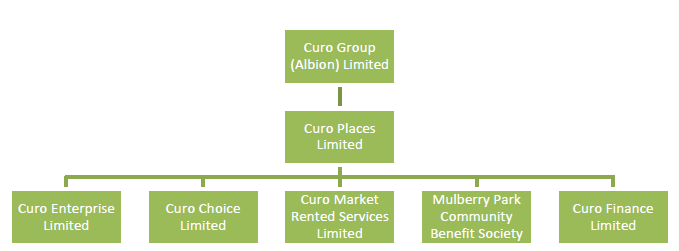
Our group structure includes the following legal entities:
Curo Group (Albion) Limited: is the ultimate parent and provides strategic, management and support services to the rest of the Group. Curo Group (Albion) Limited is a charitable Community Benefit Society registered with the Financial Conduct Authority and a Registered Provider of Social Housing.
Curo Places Limited: is our core landlord business, managing social homes, prodominantly in the South West of England region. Curo Places Ltd is a charitable Community Benefit Society registered with the Financial Conduct Authority and a Registered Provider of Social Housing.
Curo Choice Limited: is a specialist housing and support business, which provides services to both residents and non-residents to enable them to live independently. Curo Choice Ltd is a charitable Community Benefit Society registered with the Financial Conduct Authority.
Curo Enterprise Limited: is a housebuilding company, generating income and delivering additional affordable housing to our core business. Curo Enterprise Ltd is a company limited by shares. All the shares are owned by Curo Places Limited.
Curo Market Rented Services Limited: is a private market rented company which provides much needed rented housing mainly in Bath and the surrounding area generating additional revenues to support our core business. Curo Market Rented Services is a company limited by shares. All the shares are owned by Curo Places Limited.
Mulberry Park Community Benefit Society: was established for the benefits of the community around Mulberry Park in Bath and provides community services and estate management services for recreational and community purposes. It is a charitable Community Benefit Society registered with the Financial Conduct Authority.
Curo Finance Limited: was established in order to act as the main contractor under development agreements with Curo Places Limited. It is a company limited by shares. All of the shares are owned by Curo Places Limited.
Group Structure
The current group structure is summarised below:
Strategic priorities
During 2024 we launched our 10 year strategic plan and vision, that by 2034 ’Everyone feels proud of the quality of our homes’. This is a statement we designed with the support of our colleagues and customers.
We aim to make our vision come to life through the following five strategic objectives:
- Quality Homes
- Purposeful Culture
- Trusted Customer Services
- Collaboration and Growth
- Solid Foundations
Review of the Year
The 2025/26 year marked year two of our new Strategic Plan, with a continued emphasis on laying solid foundations. The key focus areas during the year were:
Strategic Objective 1: Quality Homes aims to ensure all Curo homes are well looked after, energy efficient, meet modern day standards and inspire pride.
Asset Strategy: as a social housing landlord we work to alleviate housing need through the provision of quality, long-term, affordable homes for people who are unable to access the private rented sector or home ownership. The housing solutions we provide play a vital role in creating stable environments where residents can feel safe and secure, and often act as a springboard for more successful lives. Curo’s purpose, ’Homes for Good’, and our strategy, that by 2034 “everyone feels proud about the quality of our homes”, strongly reflect this ambition and underline the importance of our asset portfolio in delivering it.
Following the finalisation of our asset strategy in 2025, we have focused on producing a Homes and Places Standard designed to drive and measure pride in homes. The Standard sets out what good looks like, promising to deliver homes that are comfortable, safe, energy efficient and welcoming for everyone.
All Curo properties are in the process of being graded. This will create a baseline of the condition of every home and estate across four categories: thriving, working well, falling behind and needs attention.
In support of this approach we have ringfenced investment funding over the next five years, providing greater certainty and enabling a longer-term, data-led approach to prioritising resources where they will have the greatest impact.
Great Green Upgrade is a three-year project that commenced in 2025; it will see more than 1,000 households across Bath and Bristol getting improvements to their homes, which could include solar panels, improved insulation, new windows and doors, and upgraded heating systems.
A total investment of £18m has been ringfenced to deliver the programme, including £5m awarded through the Government’s Warm Homes scheme. The initiative supports our wider ambition to improve the energy efficiency of our homes, with a target of ensuring as many properties as possible achieve an Energy Performance Certificate (EPC) rating of C or above by 2030.
During the year we completed retrofit works to 171 properties. Improvements included the installation of new windows, doors, insulation, solar photovoltaic (PV) panels and improved ventilation. Properties are comfortably achieving the EPC C threshhold and customer feedback has been highly positive as they experience reductions in energy bills.
We aim to retrofit energy efficiency works to a further 400 properties during the coming year across our homes in Twerton, Whiteway, Foxhill and Midsomer Norton.
Demonstrating compliance with Awaab’s Law:
Following the introduction of Awaab’s Law in October 2025, we have continued to strengthen our approach to ensuring customers live in safe, comfortable and healthy homes, with prompt action taken in response to damp, mould and other serious hazards.
During the year we addressed 2,696 hazards, achieving overall compliance of 88%. Performance improved significantly during the latter part of the year with 93% successfully completed within the required timescales during February and March. This compares favourably with the sector median of 90% reported by Housemark.
Strategic Objective 2: Purposeful Culture aims to create a high-performing and engaged organisation which attracts, develops and retains diverse, talented people.
Colleague engagement at Curo remained strong and stable during the year, including maintaining a notable step change in satisfaction levels from our trades colleagues following a range of initiatives to listen and act on their ideas.
We were delighted to be ranked again by Best Companies as a 2-star organisation, meaning our colleagues rate us as an 'outstanding' place to work. This was reinforced by our Gold accreditation from Investors in People and a further Silver accreditation for Wellbeing, the first time we’ve been assessed in this area.
Leadership Training: enhancing leadership skills and behaviours is crucial to successfully achieving our vision. During the year we have delivered a comprehensive Leadership Development Programme focusing on leading self, others and the business. Key areas include: leadership behaviours, giving and receiving feedback, professional skills, outside in-thinking and business knowledge. This programme was delivered to all colleagues within the Leadership Group with a view to rolling this out to the next cohort of managers in 2026.
Strategic Objective 3: Trusted Customer Services aims to deliver high-quality, reliable services that meet the needs of our customers and communities.
Regulatory judgement: a ’C’ judgement, also known as a consumer grade, is a rating issued by the Regulator of Social Housing assessing how well a housing association meets the consumer standards introduced in 2024. These standards focus on the quality and safety of homes, tenant engagement and the delivery of services.
The RSH completed a detailed inspection of Curo in July 2025 and we are very proud to have received the highest possible rating of ’C1’.
Tenant Satisfaction Measures (TSMs): are a set of standardised measures used by landlords to assess and report on their performance. These measures have been implemented by the Regulator of Social Housing to help tenants see how well their landlord is performing and hold them accountable. They also provide the Regulator and all housing associations with data to identify areas where landlords need to improve.
TSMs cover a range of areas, including keeping properties in good repair, maintaining building safety, effective complaint handling and responsible neighbourhood management.
During the year we saw an improvement in 9 of the 14 measures of between 0.4% (Listens & Acts) to 8.6% (Communal Areas). Overall satisfaction remained relatively static at 70.2%.
We continue to use the data and insight from TSMs to focus on where we believe the biggest improvements can be made.
Embedding of new complaints approach: customer satisfaction with complaints handling remains the lowest area of satisfaction for Curo, reflecting a wider sector challenge experienced by most housing associations.
During the year we have fully embedded the new complaints process piloted in the previous year. The new approach is designed to be more straightforward for customers and to strengthen accountability by ensuring operational managers closest to the issue are responsible for finding a resolution.
As a result of this change in approach, open complaints reduced from 432 in April 2025 to 218 in March 2026, a 50% reduction. This improvement reflects faster resolution times and, importantly, a stronger focus on learning from complaints to prevent recurrence and improve service quality going forward.
Alignment of Housing and Support services: our Customer Experience Strategy is committed to creating a ‘more productive and efficient housing management service, using technology and data to enhance integration, reduce waste, and free up capacity for frontline services’.
During the year we’ve taken steps to harmonise our Housing, Support and Estate models that previously operated in parallel with separate processes, systems and management structures. Bringing this together into one model will enable us to get closer to, and improve the quality of, the service we provide to all customers.
A new operating model has been designed; the colleagues impacted by these changes have been consulted and key stakeholders have been informed of the changes which will come fully into effect during quarter one of 26/27.
Resident engagement: we remain committed to actively seeking and encouraging resident involvement and participation in shaping and scrutinising the delivery of our services. We do this in multiple ways including Board Connect, Customer Oversight Group, Voicebox, and our ’Big Get Together’ annual customer event, as well as a programme of year-round community catch-ups held across our operating area.
During the year the Customer Experience Committee continued to listen to and act upon customer feedback, ensuring that Curo services are fair, consistent, transparent, valued, and flexible. This board plays a key role in shaping services, ensuring they are aligned with customer needs and expectations.
Management of arrears: cost of living increases have continued to challenge customers’ ability to pay their rent. Rent charges for our general needs customers increased during the year by 2.7% as defined by the Government formula. This is a significantly lower increase than the previous two years.
Curo’s Money Advice Service continues to provide high quality support for residents, and offers a range of advice about money management achieving a 78% engagement rate, which compares very favourably with other free debt advice agencies. Our team helps with managing debt, accessing the correct benefits and applying for grants and charity funding, helping customers to take back control of their finances. The average amount each customer sees back in their pockets through using the service is £2,756.
During the year we also provided £187,000 of additional support through our Customer Support Fund which provides practical support for customers in financial difficulty.
Our ’collecting with care’ approach remains highly valued by our customers and is effective. This was evidenced through customer satisfaction levels with the service at 95%, coupled with bad debts below 0.4% of total rental income, which is top quartile performance when compared to peers in the sector.
Strategic Objective 4: Collaboration & Growth aims to build new homes and work with others to maximise social value and commercial revenues.
Building high quality new homes: during the year we built or acquired 140 new social homes. This was 28 less new homes than originally planned, due primarily to construction delays at a small number of sites.
We have also agreed to deliver a further 945 affordable homes over the next five years. These homes are delivered through a combination of our Strategic Partnership with Homes England, our own housebuilding company and acquisition from other property developers.
In addition to these affordable homes, we completed 91 new market sale homes and began work on a further programme of 549 private sales homes over the next five years which will be delivered by our own housebuilding company, Curo Enterprise.
Regeneration: we are currently managing two distinct regeneration projects, Tintagel Close in Keynsham and Walnut Buildings in Radstock, focused on replacing older housing with modern, energy-efficient affordable homes. These projects are now progressing well after several years of customer consultation and planning. Demolition of both sites is complete with construction of new homes underway.
Market Rent Strategy (MRS): We have a portfolio of 244 homes let within the private rental market in Bath and neighbouring areas. All profits generated from this portfolio are reinvested into our social landlord function, Curo Places.
During the year, the Board reviewed and approved a new five-year MRS strategy focused on driving commercial growth, improving the quality of homes and services and prioritising the safety and wellbeing of both customers and colleagues.
The strategy provides clear direction for the future management and development of these properties, while remaining fully aligned to Curo’s overall corporate strategy.
Strategic Objective 5: Solid Foundations aims to build an effective, sustainable and innovative organisation with strong business services that support continuous improvement.
Improving our approach to delivering change: to strengthen our approach to change across the organisation, we established a Programme Management Office (PMO) during the year. The PMO provides greater oversight of strategic projects and programmes, improving the quality of planning, monitoring and delivery. This includes the introduction of enhanced scrutiny processes, formal stage-gate reviews and clearer accountability throughout the project lifecycle. The PMO also plays a key role in ensuring that intended outcomes and benefits are clearly defined, tracked and realised, helping to maximise value from investment and support the successful delivery of organisational priorities.
The establishment of the PMO will also play a key role in supporting the ’proof-of-concept’ phase of our new IT platform programme next year. Through robust governance, effective risk management and coordinated delivery across the business, the PMO will help assess the platform’s potential benefits and support informed decision-making around any future wider rollout.
Recruitment: during the year we enhanced our recruitment approach, strengthening our hiring decisions and ability to attract high-quality talent. A key development was the appointment of a specialist Talent Acquisition Lead, bringing dedicated expertise and greater consistency to our end-to-end recruitment activity. In addition, we implemented Teamtailor software to automate and standardise core processes, improving efficiency, governance and the candidate experience.
These changes have supported more robust screening and selection, better alignment between role requirements and appointments, and a more structured, data-driven approach to workforce planning and hiring outcomes.
Governance and financial viability: the Regulator of Social Housing (RSH) publishes assessments on housing associations, setting out whether the provider is complying with the relevant governance and financial viability standards. We are proud to currently hold the highest possible ’G1’ rating for Governance and, like the majority of Housing Associations, we are graded to ’V2’ for our financial viability. This V2 grading complies with regulatory standards and reflects the increased risk in our sector as a result of caps on social rents, greater planned investment in our existing homes and stronger operating headwinds.
Financial performance: measured through the Regulator’s Value for Money metrics, we are placed in quartile 3 for five of the eight metrics that are benchmarked, with two other measures positioned in quartile 2. This outcome reflects the Board’s agreed strategic approach to prioritise increased investment in our existing homes, particularly through planned and responsive repairs, aiming to improve the standard of our homes and meet customer expectations for repairs.
The eighth metric, Operating Margin (%), sits in quartile 4, which is primarily driven by two key factors. Firstly, the inclusion of results from our housebuilder Curo Enterprise, which contributes £34m of private turnover (23% of total group turnover) and operates at relatively lower margins; a structure that is not typically reflected across many comparable housing associations. Secondly, within the social housing business, Curo has a comparatively higher average cost per unit for repairs and maintenance partly due to the historic nature of our stock. Optimising our cost per unit is a key focus of our Efficiency Plan, which is aimed at improving operational performance while maintaining service quality and investment in homes.
Principal risks
The Group maintains a comprehensive Risk and Assurance Framework, approved by the Combined Board, which sets out our approach to identifying, assessing and managing risk. This is supported by defined risk appetites, regular Board and Committee oversight, and integration with financial planning, business continuity and assurance activities.
The principal risks and uncertainties that could impact the Group’s performance, financial position and long-term viability are summarised below, together with the key mitigating actions in place.
| Risk | Comment and Curo Response |
|---|---|
| 1. Macroeconomic and financial pressures |
The Group operates in a challenging macroeconomic environment characterised by continued volatility in inflation, interest rates, construction costs and the wider housing market. These factors place pressure on the Group's cost base, borrowing costs and overall financial capacity, and may impact the delivery of the Group's strategic objectives. There is also an inherent risk associated with the delivery of the Group's efficiency plans and maintaining sufficient financial resilience to respond to emerging pressures. Curo mitigates this risk by:
|
| 2. Cyber Security and data |
The risk of a cyber security incident continues to increase across the sector and could result in disruption to services, loss or compromise of sensitive data, regulatory intervention and reputational damage. The Group’s reliance on digital systems and data, alongside an evolving threat landscape, heightens this exposure.
|
| 3. Development and property sales exposure |
The Group’s development programme includes homes for open market sale (via Curo Enterprise Limited) and shared ownership (via Curo Places Limited), creating exposure to housing market conditions, including demand, pricing and sales rates.
|
Emerging risks
We scan the horizon for any new or emerging risks that may have a positive or detrimental impact on the business or our residents, including reviewing lessons learnt from the Social Housing Regulator’s Sector Risk Profile and Regulatory Judgements. The Combined Board considers its risk appetite at least annually.
Financial Review
Financial performance for the last three years is as follows (£m).
| Statement of Comprehensive Income | 2026 | 2025 | 2024 |
|---|---|---|---|
| Turnover | 144.8 | 151.3 | 142.7 |
| Operating costs and cost of sales | (128.2) | (130.2) | (117.2) |
| Surplus on sale of assets | 5.5 | 3.6 | 3.2 |
| Impairment of stock for sale | - | (15.3) | - |
| Pension settlement charges | - | (1.0) | - |
| Operating surplus | 22.1 | 8.4 | 28.7 |
| Net interest charge and other financing costs | (14.2) | (15.3) | (14.0) |
| Fair value in investment properties | (0.4) | 0.4 | (1.1) |
| Corporation Tax | - | - | - |
| Net surplus/(deficit) surplus for the year | 7.5 | (6.5) | 13.6 |
| Statement of Finanial Position | 2026 | 2025 | 2024 |
|---|---|---|---|
| Housing properties at cost less depreciation | 751.4 | 714.4 | 679.5 |
| Investment properties at valuation | 22.4 | 18.4 | 18.1 |
| Other tangible fixed assets | 3.6 | 3.6 | 3.3 |
| Fixed assets | 777.4 | 736.4 | 700.9 |
| Net current assets | 38.7 | 25.7 | 69.2 |
| Creditors due after one year & provisions for liabilities | (536.0) | (490.4) | (492.8) |
| Net assets | 280.1 | 271.7 | 277.3 |
| Revenue reserve | 281.7 | 274.2 | 280.8 |
| Cash flow hedge reserve | (1.6) | (2.5) | (3.5) |
| Total reserves | 280.1 | 271.7 | 277.3 |
The main accounting policies of the Group are set out on pages 33 to 41 of the financial statements.
Financial Risk Management
From a financial risk perspective, Curo apply six Financial Rules. These rules are internal parameters for us to operate within and are agreed with and reported regularly to the Board. We were fully compliant with all of our six Financial Rules during the year. The six Financial Rules are:
- Interest cover EBITDA
- Interest cover EBITDA MRI (Major Repairs Included)
- Operating Margin - Social Lettings
- Maximum investment in Curo Enterprise
- Property sales as a percentage of Group operating surplus
- Secured banking facilities (number of months)
Statement of Comprehensive Income
Turnover for the year totalled £144.8m a £6.6m (4%) decrease on the previous year due to a reduction in private sales proceeds from housebuilding activities within Curo Enterprise Ltd.
Operating surplus totalled £22.1m, a £13.7m increase on the previous year. Prior year results included £16.3m of one-off accounting adjustments relating to the impairment of Curo Enterprise’s stock held for sale coupled with pension charges following our exit from the Social Housing Pension Scheme.
Reserves
As a result of the activities described above, we are reporting a net surplus for the year totalling £7.5m (2025: deficit of £6.5m), increasing our revenue reserves to £281.7m as at 31 March 2026 (2025: £274.2m). We will invest this in delivery of new homes, maintaining and improving our existing homes and improving our services to residents.
Statement of Financial Position
Some key Statement of Financial Position facts as at 31 March 2026 are:
- Housing properties depreciated cost £751m (an increase of £37m in the year).
- Homes in management now total 14,371 (2025: 14,264)
- Net current assets totalled £39m (2025: £26m)
Cash flow
Cash flows for the year are set out in the cash flow statement on page 32.
During the year cash balances increased by £57m to £68m. Key highlights include:
- Net cash inflow from operating activities of £51m (2025: £53m)
- During the year £54m (2025: £48m) of investment was made in new and existing social homes.
- Cash inflow of £24m (2025: cash outflow of £30m) from the net cash inflow of new loans drawn exceeding the repayment of existing borrowings.
Capital structure and treasury strategy
The Group has a formal treasury management strategy, which is regularly reviewed. The purpose of the policy is to ensure that we have sufficient funding for the medium term and to establish the framework within which the Group seeks to protect and control risk and exposure in respect of its borrowings and cash holdings. The treasury strategy addresses funding and liquidity risk and covenant compliance.
The Group has one active borrower, Curo Places Ltd, which borrows on bilateral bonds, bilateral and syndicated loan agreements.
Borrowing and arranged facilities, as at 31 March 2026, can be summarised as follows:
Arranged £m
Curo Places 498.3
Drawn £m
Curo Places 408.3
At 31 March 2026, the Group had £90m (2025: £140m) of arranged facilities that were not drawn. Cash held or on deposit at the year-end totalled £67.5m (2025: £10.4m), leaving net debt of £340.8m (2025: £355.8m).
The weighted average period for drawn fixed debt is 19 year 10 months (2025: 17 years 7 months). Approximately £45m of existing drawn loans are due to be repaid in the next five years. The weighted average cost of debt, inclusive of margins and hedging activities, as at 31 March 2026 was 4.1% (2025: 4.4%).
There are four intercompany loan arrangements currently in place, all facilities are repayable on demand;
- £10m loan facility between Curo Places Ltd (lender) and Curo Enterprise Ltd (borrower);
- £35m loan facility between Curo Places Ltd (lender) and Curo Market Rented Services Ltd (borrower); and
- £1.1m loan facilities between Curo Places Ltd (lender) and Mulberry Park Community Benefit Society (borrower).
- £1m loan facilities between Curo Places Ltd (lender) and Curo Finance Limited (borrower).
Current liquidity
The Group holds a minimum cash holding of £5 million, which is placed on instant access deposits to ensure short term liquidity. These deposits are spread over a number of banks which meet our investment criteria in respect of creditworthiness and approved limits.
Interest rate management
The Group has actively managed its loan portfolio, seeking to take advantage of low long-term interest rates. In this way the Group can achieve certainty in terms of interest rate cost but in the short term can still borrow at the very low variable rates currently on offer.
As at 31 March 2026, the percentage of fixed and variable rate loans was as follows, fixed 92% (2025: 87%) variable 8% (2025: 13%).
Loan covenant compliance
Loan covenants are primarily determined by interest cover and asset cover, based on social housing values. Both financial and non-financial covenants are monitored regularly and were met throughout the year and at the year end for all loan facilities.
Investment for the future
The Group is committed to spending approximately £50m annually over each of the next five years to maintain and improve its existing housing stock. It plans to maintain a balance of 40:60 in spreading this expenditure between day to day responsive repairs and planned works.
Environmental, social and governance reporting (ESG)
Annually the Group prepares an ESG report. The latest update for this financial year will be available on our company website from Autumn 2026.
Value for Money - Strategy
Curo’s VFM strategy plays an integral part of how it delivers the strategic priorities set out in the Strategic Plan. The Group is committed to delivering its strategic priorities whilst also driving value for money for the benefit of our customers and other stakeholders alike.
We have the following strategic priorities, all of which have associated strategic goals that focus on delivering VfM:
| Strategic Priorities | Key VfM goals |
|---|---|
| 1. Quality Homes | To invest in our homes and shared spaces to ensure they are well looked after, energy efficient, meet modern day standards and inspire pride. To understand the future financial return on our assets and actively manage this to optimise VfM for our customers. |
| 2. Purposeful Culture | To create a high-performing and engaged organisation which is always looking to operate in the most effective way for the benefit of customers. |
| 3. Trusted Customer Services | To provide services our customers need, optimising the service standard to provide VfM and acting on customer feedback to improve efficiency and effectiveness. |
| 4. Collaboration and Growth | To continue to innovate, working with a range of strategic partners to build more new homes each year, deliver services our customers truly value and optimise the financial returns on our commercial activities to reinvest in our social purpose. |
| 5. Solid Foundations | To continue to operate using sound financial, governance and data-led practices, maintaining our strong regulatory rating, and investing in our colleagues and technology to drive VfM. |
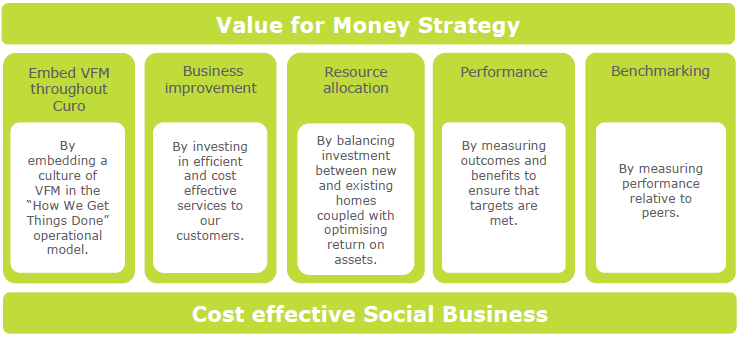
Our VfM strategy combines 5 activities which, collectively ensure that we run a cost-effective social enterprise business by defining targets, setting plans to achieve these targets, and measuring how we perform against those targets.
Embed VfM throughout Curo
The principal aim of VfM is to ensure that the delivery of the Strategic Plan is carried out with optimum efficiency within the resources available to Curo. Each year, during the financial planning cycle, the Board consider allocation of resources and the impact that has on delivering the Strategic Plan and our VfM metrics. The Board therefore are conscious at all times of the impact of strategic decisions on VfM metrics.
Once resource allocation is agreed at a strategic level, accountability and responsibility for cost and quality outcomes are translated into operational targets through budgets, team plans and individual performance objectives, which is depicted in our “How We Get Things Done” model:

Business improvement
Our Strategic Plan contains investment plans for improved IT, people, and data services, which will improve the equipment, systems, capability and information required for our colleagues to deliver improved services for our customers.
Resource allocation
The Board take investment decisions considering the impact on the Strategic Goals and VfM metrics. Our development and asset management strategies seek to optimise our return on assets. Decisions are taken based on both financial and qualitative analysis of our existing homes at a variety of levels (unit, block, estate, and business stream) to identify any outliers that require further investigation or intervention.
Performance
Curo uses a set of Key Performance Indicators to measure performance targets against our Strategic Goals, which aligns targets to customer, financial, growth, colleague, and asset & safety delivery aspirations. Performance is reported and discussed with the Board regularly. The performance culture with colleagues at Curo is strong with clear accountability, transparency, and a collective drive to achieve stretch targets.
Benchmarking
Benchmarking is a key part of delivering VfM within Curo whilst bearing in mind the relative differences in size, business model and composition of stock. Curo is a member of a benchmarking club where we share operational and financial information that allow cost and quality performance comparisons to be made. The Board is periodically updated with the relative performance of Curo against our peers for all VfM metrics.
Value for Money - Performance 2025/26
2025/26 Performance
The table below summarises our VFM performance against the following metrics for 2025/26:
| Performance Metric | 2025/26 | |||
|---|---|---|---|---|
| Actual | Target | Better/(worse) | Quartile (*) | |
| Business health & efficiency | ||||
| Operating margin % - Social housing lettings only | 16.2% | 17.5% | ▼ (worse) | Q4 |
| Operating margin % - Consolidated | 11.5% | 12.0% | ▼ (worse) | Q3 |
| Interest cover % (EBITDA MRI) | 98% | 81% | ▲ (better) | Q3 |
| Headline social housing cost per unit £ CPU – Curo Places Ltd. (entity level) | £5,865 | £5,919 | ▲(better) | Q3 |
| Return on capital employed % | 2.7% | 2.7% | ▶ (neutral) | Q3 |
| Development & investment | ||||
| New supply delivered % - Social housing units | 1.1% | 1.3% | ▼ (worse) | Q3 |
| New supply delivered % - Non-social housing units | 0.6% | 0.8% | ▼ (worse) | n/a |
| Gearing % | 45% | 53% | ▲ (better) | Q2 |
| Reinvestment % | 7.7% | 7.3% | ▲ (better) | Q2 |
* Note: Benchmark quartile compares 2025/26 actual results against the latest published sector results (2024/25) as reported by the regulator in the Value for Money Metrics and Reporting 2025.
2025/26 Performance Highlights
Performance during the year has been mixed with 5 of the 9 VfM measures either in line, or exceeding the targets set.
Compared to our peers, performance across the eight benchmarkable VfM measures places us in quartile 2 or 3 for seven of them, with one measure (Operating Margin %) in quartile 4.
The commentary below explains the rationale why performance fell short of target on the remaining four measures:
a) Operating Margin: Consolidated and Social Lettings Margin
Curo outperformed its consolidated budgeted operating surplus during FY 25-26 with higher proceeds from property sales offsetting unplanned increases in reactive repair costs. However, both of the VfM operating margin metrics exclude any benefit from property disposals of existing homes resulting in performance below target for the year.
The reported consolidated overall operating margin of 11.5% is marginally lower than the quartile 3 level of 11.8%. As a result when benchmarked against peer performance in FY 24-25, Curo is positioned within quartile 4.
The comparatively low level of margin is driven by two key factors.
Firstly, the consolidated results include our housebuilding subsidiary, Curo Enterprise, which generated £34m of private sale turnover during the year, representing 23% of total group turnover. Housebuilding activities typically operate at lower margins than core social housing activities and are not commonly as proportionally high within many comparable housing associations.
Secondly, within the social housing business, Curo has a comparatively higher average cost per unit for repairs and maintenance. Addressing this is a key focus of our Efficiency Plan, which is aimed at improving operational performance while maintaining service quality and investment in homes.
b) Lower than planned levels of new housing supply (social and non-social)
During the year we acquired 140 new social homes, 28 less than originally targeted. The shortfall is mainly due to construction delays at one scheme, Imperial Park Bristol.
Value for Money - Future targets 2026/27
The table below shows the trajectory of results for the last three years on VFM metrics, together with our plans and targets for 2026/27:
| Performance Metric | 2023/24 Actual | 2024/25 Actual # | 2025/26 Actual | 2026/27 Target | Quartile (*) |
|---|---|---|---|---|---|
| Business health & efficiency | |||||
| Operating margin % - Social housing lettings only | 23.8% | 19.0% | 16.2% | 16.7% | Q3 |
| Operating margin % - Consolidated | 17.8% | 14.0% | 11.5% | 11.9% | Q3 |
| Interest cover % (EBITDA MRI) | 140% | 112% | 98% | 83% | Q3 |
| Headline social housing cost per unit £ CPU – Curo Places Ltd. (entity level) | £4,850 | £5,644 | £5,865 | £6,684 | Q3 |
| Return on capital employed % | 3.7% | 3.3% | 2.7% | 2.5% | Q3 |
| Development & investment | |||||
| New supply delivered % - Social housing units | 1.9% | 0.9% | 1.1% | 1.5% | Q2 |
| New supply delivered % - Non-social housing units | 0.8% | 0.8% | 0.6% | 0.7% | n/a |
| Gearing % | 54% | 50% | 45% | 54% | Q3 |
| Reinvestment % | 8.8% | 7.9% | 7.7% | 9.5% | Q2 |
* Note 1: Benchmark quartile compares 2026/27 budget targets against the latest published sector results (2024/25) as reported by the regulator in the Value for Money Metrics and Reporting 2025.
# Note 2: During 2024/25 our financial results were adversely affected by two material one-off accounting adjustments totalling £16.3m:
- Impairment charges totalling £15.3m, relating to the write down of stock value within Curo Enterprise.
- Pension charges of £1.0m relating to the exit of the SHPS defined benefit scheme.
These one-off charges had a significant impact on three of our Value for Money metrics (Operating Margin % - Consolidated, Interest Cover EBITDA MRI and Return on Capital Employed). To allow for a more accurate comparison of underlying performance against other years, VfM performance reported for 2024/25 has been adjusted to exclude the impact of the one-off adjustments.
Summary
Each year during the financial planning cycle the Board consider allocation of resources and the impact that has on delivering the Strategic Plan and our VfM metrics. In order to deliver the strategic priorities outlined in the Strategic Plan, the Board agreed to make substantial increases in the level of investment in our existing stock. The Board also agreed to make additional funds available to prioritise further investment around IT systems, change management, data and leadership training and development.
As a result of the increased level of investment planned next financial year almost all VfM metric targets are set in the lower quartiles when compared to the latest available sector median from FY 2024/25.
The Board are conscious of the risk this brings and are mitigating it through the creation of the ‘Efficiency Plan’ targeting operational savings to bring financial performance back in line with sector median.
Key highlights relating to 2026/27 targets are explained below:
a) Interest cover and gearing
Interest cover and gearing are measures of an organisation’s ability to take on more debt to support the delivery of new homes and improvements to existing stock, and its ability to cover ongoing finance costs from operating activities.
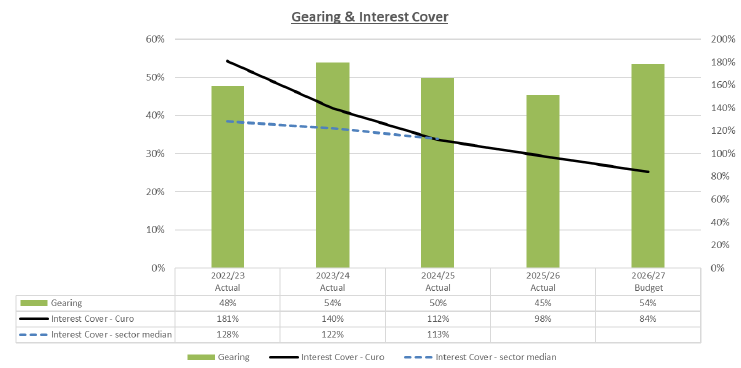
Historically, Curo’s level of gearing has been high in comparison with our peers with benchmark comparisons regularly showing us at quartile 3. As at 31 March 2026, our level of gearing was 45% marginally better than median performance. This is bolstered in the short term by a large temporary cash balance, including £20m of grant funding that will be distributed to our development partners in the near future.
The graph below shows that Curo’s interest cover, which has consistently remained well above the sector median in the past, is on a declining trajectory mirroring the reductions being experienced elsewhere in the sector.
Interest cover in our Financial Plan is projected to decrease in 26/27 but return to more sustainable levels above 100% by 2028 primarily driven by savings targeted in the Efficiency Plan which commences during 2026/27.
b) Operating Margin % (Social Lettings)
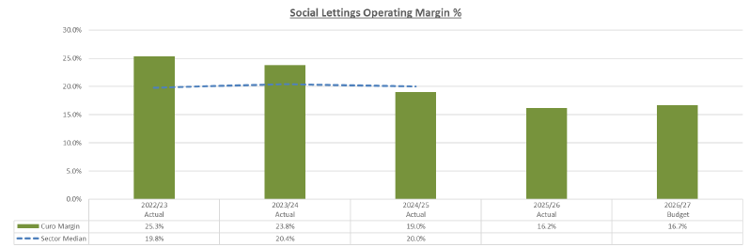
Curo’s Social Lettings margin has reduced over the last two years as we increase the level of investment in planned works to our existing homes, whilst also dealing with rising levels of reactive and specialist repairs.
Managing this performance indicator forms an integral part of our internal Financial Rules ensuring that our core landlord business remains financially resilient to future challenges.
The table below charts actual performance over the last 4 years and how that compares to sector median which has remained relatively constant at 20% over the last 3 years.
c) Reinvestment + new social homes %
Two integral parts of our strategy include:
- Invest in homes and shared spaces to make them comfortable, safe, energy efficient and welcoming for everyone; and
- Build more homes – the high-quality, energy-efficient and affordable homes that our region needs
Historically Curo have performed strongly against our peers on these two metrics with above median performance reflecting our appetite to create new homes and investment in our existing homes. 2026/27 targets for both metrics are quartile 2.
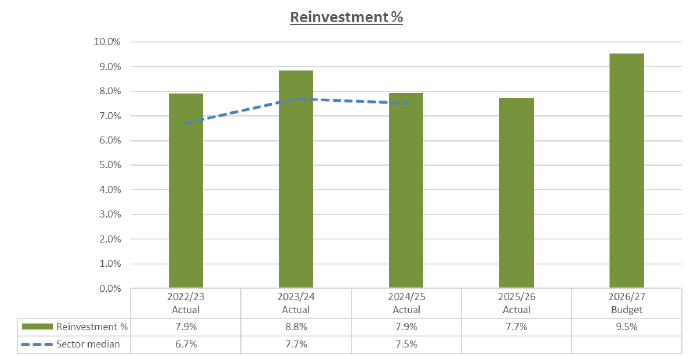
d) Social Cost per Unit (CPU)
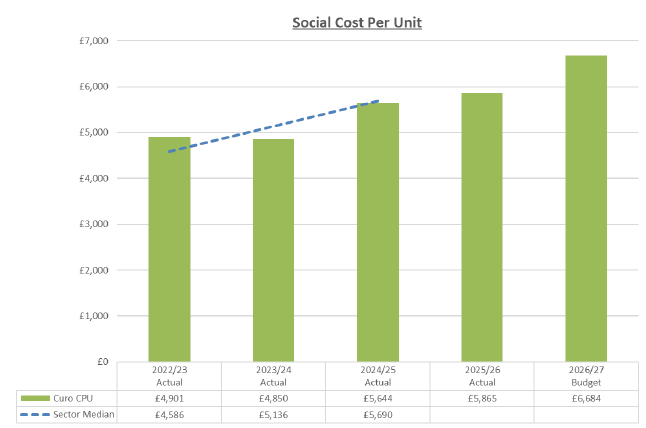
Curo’s CPU has increased by £964 (20%) over the last 3 years mirroring the increase in cost bases across the sector as illustrated below.
We analyse our CPU in detail which shows us that we have low management costs (quartile 1) in comparison to our peers but high levels of repairs and maintenance costs (quartile 3 and 4).
Budget 26/27 includes over £3m of targeted savings linked to an Efficiency Plan to drive higher levels of value for money across the social business with a wide range of initiatives in place to deliver this.
The Group Strategic Report was approved by the Board on 3 August 2026 and signed on its behalf by:
Independent auditor’s report to the members of Curo Group (Albion) Ltd
Report on the audit of the financial statements
Opinion
In our opinion:
- the financial statements give a true and fair view of the state of the Group and of the Company’s affairs as at 31 March 2026 and of the Group and the Company’s surplus and the Group’s cash flows for the year then ended;
- the financial statements have been properly prepared in accordance with United Kingdom Generally Accepted Accounting Practice; and
- the financial statements have been prepared in accordance with the requirements of the Co-operative and Community Benefit Societies Act 2014, the Co-operative and Community Benefit Societies (Group Accounts) Regulations 1969, the Housing and Regeneration Act 2008 and the Accounting Direction for Private Registered Providers of Social Housing 2022.
We have audited the financial statements of Curo Group (Albion) Limited (“the Company”) and its subsidiaries (“the Group”) for the year ended 31 March 2026 which comprise of the following: Consolidated and Company Statement of Comprehensive Income, Consolidated and Company Statement of Financial Position, Consolidated and Company Statement of Changes in Equity, Consolidated Statement of Cashflows and notes to the financial statements, including summary of significant accounting policies.
The financial reporting framework that has been applied in their preparation is applicable law and United Kingdom Accounting Standards, including Financial Reporting Standard 102 The Financial Reporting Standard applicable in the UK and Republic of Ireland (United Kingdom Generally Accepted Accounting Practice).
Basis for opinion
We conducted our audit in accordance with International Standards on Auditing (UK) (“ISAs (UK)”) and applicable law. Our responsibilities under those standards are further described in the Auditor’s responsibilities for the audit of the financial statements section of our report. We believe that the audit evidence we have obtained is sufficient and appropriate to provide a basis for our opinion.
Independence
We remain independent of the Group and the Company in accordance with the ethical requirements that are relevant to our audit of the financial statements in the UK, including the FRC’s Ethical Standard, and we have fulfilled our other ethical responsibilities in accordance with these requirements.
Conclusions relating to going concern
In auditing the financial statements, we have concluded that the board members’ use of the going concern basis of accounting in the preparation of the financial statements is appropriate.
Based on the work we have performed, we have not identified any material uncertainties relating to events or conditions that, individually or collectively, may cast significant doubt on the Group or the Company’s ability to continue as a going concern for a period of at least twelve months from when the financial statements are authorised for issue. However, because not all future events or conditions can be predicted, this statement is not a guarantee as to the Group and the Company’s ability to continue as a going concern.
Our responsibilities and the responsibilities of the board with respect to going concern are described in the relevant sections of this report.
Other information
The board are responsible for the other information. The other information comprises the information included in the Annual Report, other than the financial statements and our auditor’s report thereon. Our opinion on the financial statements does not cover the other information and, except to the extent otherwise explicitly stated in our report, we do not express any form of assurance conclusion thereon.
Our responsibility is to read the other information and, in doing so, consider whether the other information is materially inconsistent with the financial statements or our knowledge obtained in the course of the audit or otherwise appears to be materially misstated. If we identify such material inconsistencies or apparent material misstatements, we are required to determine whether this gives rise to a material misstatement in the financial statements themselves. If, based on the work we have performed, we conclude that there is a material misstatement of this other information we are required to report that fact.
We have nothing to report in this regard.
Matters on which we are required to report by exception
We have nothing to report in respect of the following matters where we are required by the Co-operative or Community Benefit Societies Act 2014 to report to you if, in our opinion:
- the Association has not kept proper books of account;
- the Association has not maintained a satisfactory system of control over its transactions;
- the financial statements are not in agreement with the Association’s books of account; or
- we have not received all the information and explanations we need for our audit.
Responsibilities of the board
As explained more fully in the Statement of Board’s responsibilities, the board is responsible for the preparation of the financial statements and for being satisfied that they give a true and fair view, and for such internal control as the board members determine is necessary to enable the preparation of financial statements that are free from material misstatement, whether due to fraud or error.
In preparing the financial statements, the board are responsible for assessing the Group and the Company’s ability to continue as a going concern, disclosing, as applicable, matters related to going concern and using the going concern basis of accounting unless the board either intend to liquidate the Group or the Company or to cease operations, or have no realistic alternative but to do so.
Auditor’s responsibilities for the audit of the financial statements
Our objectives are to obtain reasonable assurance about whether the financial statements as a whole are free from material misstatement, whether due to fraud or error, and to issue an auditor’s report that includes our opinion. Reasonable assurance is a high level of assurance, but is not a guarantee that an audit conducted in accordance with ISAs (UK) will always detect a material misstatement when it exists. Misstatements can arise from fraud or error and are considered material if, individually or in the aggregate, they could reasonably be expected to influence the economic decisions of users taken on the basis of these financial statements. However, the primary responsibility for the prevention and detection of fraud rests with both those charged with governance of the Company and management.
Extent to which the audit was capable of detecting irregularities, including fraud
Irregularities, including fraud, are instances of non-compliance with laws and regulations. We design procedures in line with our responsibilities, outlined above, to detect material misstatements in respect of irregularities, including fraud. The extent to which our procedures are capable of detecting irregularities, including fraud is detailed below:
Non-compliance with laws and regulations
Based on:
- Our understanding of the Group and the industry in which it operates;
- Discussion with management; those charged with governance and the Audit and Assurance Committee and;
- Obtaining and understanding of the Group’s policies and procedures regarding compliance with laws and regulations.
We considered the significant laws and regulations to be the applicable accounting framework, UK tax legislation and the Housing and Regeneration Act 2008.
The Group is also subject to laws and regulations where the consequence of non-compliance could have a material effect on the amount or disclosures in the financial statements, for example through the imposition of fines or litigations. We identified such laws and regulations to be [the health and safety legislation, employment law, the Regulator of Social Housing’s Regulatory Standards, fire safety legislation and data protection legislation.
Our procedures in respect of the above included:
- Enquires of management whether there were any litigations and claims;
- Enquires of the legal team of the Group and the Company;
- Review of minutes of meetings of those charged with governance for any instances of non-compliance with laws and regulations;
- Review of correspondence with regulatory and tax authorities for any instances of non-compliance with laws and regulations;
- Review of financial statement disclosures and agreeing to supporting documentation;
- Involvement of tax specialists in the audit; and
- Review of legal expenditure accounts to understand the nature of expenditure incurred.
Fraud
We assessed the susceptibility of the financial statements to material misstatement, including fraud. Our risk assessment procedures included:
- Enquiry with management, those charged with governance, the Audit and Assurance Committee and internal audit regarding any known or suspected instances of fraud;
- Obtaining an understanding of the Group’s policies and procedures relating to:
- Detecting and responding to the risks of fraud; and
- Internal controls established to mitigate risks related to fraud.
- Review of minutes of meetings of those charged with governance for any known or suspected instances of fraud;
- Discussion amongst the engagement team as to how and where fraud might occur in the financial statements;
- Performing analytical procedures to identify any unusual or unexpected relationships that may indicate risks of material misstatement due to fraud;
- Considering remuneration incentive schemes and performance targets and the related financial statement areas impacted by these; and
- Review of revenue recognition relating to property sales.
Based on our risk assessment, we considered the areas most susceptible to fraud to be journal entries, judgements and estimates and revenue recognition relating to property sales.
Our procedures in respect of the above included:
- Testing all journal entries that met defined risk criteria, as well as a random sample from the non-risky population, by agreeing to supporting documentation;
- Reading minutes of meetings of those charged with governance, reviewing internal audit reports and reviewing correspondence with HMRC and the Regulator of Social Housing Assessing significant estimates made by management for bias; and
- Testing the accuracy, completeness and cut-off relating to property sales.
We also communicated relevant identified laws and regulations and potential fraud risks to all engagement team members who were all deemed to have appropriate competence and capabilities and remained alert to any indications of fraud or non-compliance with laws and regulations throughout the audit.
Our audit procedures were designed to respond to risks of material misstatement in the financial statements, recognising that the risk of not detecting a material misstatement due to fraud is higher than the risk of not detecting one resulting from error, as fraud may involve deliberate concealment by, for example, forgery, misrepresentations or through collusion. There are inherent limitations in the audit procedures performed and the further removed non-compliance with laws and regulations is from the events and transactions reflected in the financial statements, the less likely we are to become aware of it.
A further description of our responsibilities for the audit is available on the Financial Reporting Council’s website at: www.frc.org.uk/auditorsresponsibilities. This description forms part of our auditor’s report.
Use of our report
This report is made solely to the members of the Company, as a body, in accordance with the Housing and Regeneration Act 2008 and the Co-operative and Community Benefit Societies Act 2014. Our audit work has been undertaken so that we might state to the Company’s members those matters we are required to state to them in an auditor’s report and for no other purpose. To the fullest extent permitted by law, we do not accept or assume responsibility to anyone other than the Company and the members as a body, for our audit work, for this report, or for the opinions we have formed.
BDO LLP
Statutory Auditor
London
Date: 05 August 2026
BDO LLP is a limited liability partnership registered in England and Wales (with registered number OC305127).
Consolidated and Company Statement of Comprehensive Income
For the year ended 31 March 2026
| Description | Note | Group 2026 (£000) | Group 2025 (£000) | Company 2026 (£000) | Company 2025 (£000) |
|---|---|---|---|---|---|
| Turnover | 5 | 144,793 | 151,356 | 9,592 | 7,972 |
| Operating expenditure | 5 | (128,143) | (130,175) | (9,588) | (7,967) |
| Gain on disposal of property, plant and equipment | 5,7 | 5,478 | 3,589 | - | - |
| Impairment of stock | 5 | - | (15,332) | - | - |
| Pension settlement charges | 5,26 | - | (1,011) | - | - |
| Operating surplus | 5 | 22,128 | 8,427 | 4 | 5 |
| Interest receivable | 8 | 1,335 | 414 | 51 | 6,793 |
| Interest payable and similar charges | 9 | (15,622) | (15,736) | - | (6,726) |
| Other financing costs | - | - | - | - | |
| Movement in fair value of investment properties | 15 | (391) | 360 | - | - |
| Surplus/(deficit) on ordinary activities before taxation | 7,450 | (6,535) | 55 | 72 | |
| Taxation | 13 | - | - | - | - |
| Surplus/(deficit) for the year | 10 | 7,450 | (6,535) | 55 | 72 |
| Other comprehensive income | |||||
| Change in fair value of hedged financial instruments | 988 | 904 | - | - | |
| Other comprehensive income | 988 | 904 | - | - | |
| Total comprehensive income/(expenditure) for the year | 8,438 | (5,631) | 55 | 72 | |
Consolidated and Company Statement of Financial Position
As at 31 March 2026
| Description | Note | Group 2026 (£000) | Group 2025 (£000) | Company 2026 (£000) | Company 2025 (£000) |
|---|---|---|---|---|---|
| Fixed assets | |||||
| Housing properties | 14 | 751,381 | 714,371 | 106 | 108 |
| Investment properties | 15 | 22,382 | 18,441 | - | - |
| Other property, plant & equipment | 16 | 3,627 | 3,583 | - | - |
| Total fixed assets | 777,390 | 736,395 | 106 | 108 | |
| Current assets | |||||
| Debtors: amounts falling due after more than one year | 18 | - | - | - | - |
| Stocks | 17 | 81,831 | 100,130 | - | - |
| Debtors: amounts falling due within one year | 18 | 12,790 | 14,001 | 310 | 111 |
| Cash and cash equivalents | 67,518 | 10,431 | 1,414 | 1,248 | |
| Total current assets | 162,139 | 124,562 | 1,724 | 1,359 | |
| Creditors: amounts falling due within one year | 19 | (123,406) | (98,911) | (748) | (440) |
| Net current assets | 38,733 | 25,651 | 976 | 919 | |
| Total assets less current liabilities | 816,123 | 762,046 | 1,082 | 1,027 | |
| Creditors: amounts falling due after more than one year | 20 | (534,310) | (487,931) | (37) | (37) |
| Provision for liabilities and charges | 21 | (1,706) | (2,446) | - | - |
| Net assets | 280,107 | 271,669 | 1,045 | 990 | |
| Capital and reserves | |||||
| Revenue reserve | 281,683 | 274,233 | 1,045 | 990 | |
| Cash flow hedge reserve | (1,576) | (2,564) | - | - | |
| Total capital and reserves | 280,107 | 271,669 | 1,045 | 990 |
The financial statements on pages 29 to 59 were authorised for issue by the Board of Directors on 3 August 2026 and were signed on its behalf.
Consolidated and Company Statement of Changes in Equity
For the year ended 31 March 2026
Group Consolidated
| Description | Cash flow hedge reserve (£000) | Revenue reserve (£000) | Total (£000) |
|---|---|---|---|
| At 1 April 2024 | (3,468) | 280,768 | 277,300 |
| Deficit for the year | - | (6,535) | (6,535) |
| Change in fair value of hedged financial instruments | 904 | - | 904 |
| At 31 March 2025 | (2,564) | 274,233 | 271,669 |
| Surplus for the year | - | 7,450 | 7,450 |
| Change in fair value of hedged financial instruments | 988 | - | 988 |
| At 31 March 2026 | (1,576) | 281,683 | 280,107 |
Company
| Description | Revenue reserve (£000) | Total (£000) |
|---|---|---|
| At 1 April 2024 | 918 | 918 |
| Surplus for the year | 72 | 72 |
| At 31 March 2025 | 990 | 990 |
| Surplus for the year | 55 | 55 |
| At 31 March 2026 | 1,045 | 1,045 |
Consolidated Statement of Cash Flows
For the year ended 31 March 2026
| Description | Notes | Group 2026 (£000) | Group 2025 (£000) |
|---|---|---|---|
| Net cash inflow from operating activities | 31 | 51,013 | 53,313 |
| Cash flows from investing activities | |||
| Purchase of fixed assets – housing properties | (53,535) | (47,524) | |
| Purchase of fixed assets – other | 16 | (586) | (857) |
| Proceeds from sale of fixed assets | 145 | 807 | |
| Grant received | 34,383 | 22,445 | |
| Interest received | 1,335 | 414 | |
| Net cash used in investing activities | (18,258) | (24,715) | |
| Cash flows from financing activities | |||
| Interest paid | (17,763) | (17,806) | |
| New loans | 74,000 | 70,172 | |
| Repayment of borrowings | (31,905) | (82,848) | |
| Net cash inflows/(outflows) from financing activities | 24,332 | (30,482) | |
| Increase/(decrease) in cash and cash equivalents in the year | 57,087 | (1,884) | |
| Cash and cash equivalents at the beginning of the year | 10,431 | 12,315 | |
| Cash and cash equivalents at the end of the year | 67,518 | 10,431 |
Curo Group – Accounting Policies
Notes to the Financial Statements for the Year ended 31 March 2026
1) General information
Curo Group (Albion) Limited (‘the Company’) and its subsidiaries (together ‘‘the Group’’) operate a not-for-profit housing and support organisation based in Bath, providing affordable homes and high quality care and support services across the West of England.
Curo Group (Albion) Ltd. is a charitable Community Benefit Society registered with the Financial Conduct Authority. The Company is also registered with the Regulator of Social Housing as a social housing provider. Curo Group (Albion) Ltd. registered office is The Maltings, River Place, Lower Bristol Road, Bath BA2 1EP.
Curo Choice Ltd. (registered company number 24208R), Curo Market Rented Services Ltd. (company registration 4705482) and Mulberry Park Community Benefit Society (registered company number 7696) also form part of the consolidated Group and are exempt from the requirements of carrying out an external audit under section 479A of the Companies Act 2016.
2) Statement of compliance
The financial statements have been prepared in accordance with applicable law and UK accounting standards (United Kingdom Generally Accepted Accounting Practice) which for the Group includes the Co-operative and Community Benefit Societies Act 2014, the Co-operative and Community Benefits Societies (Group Accounts) regulations 1969, FRS 102 “the Financial Reporting Standard applicable in the United Kingdom and the Republic of Ireland”, the Statement of Recommended Practice (SORP) for Registered Social Housing Providers 2018, the Accounting Direction for Private Registered Providers of Social Housing 2022.
3) Summary of significant accounting policies
The principal accounting policies applied in the preparation of these consolidated and separate financial statements are set out below. These policies have been consistently applied to all the years presented, unless otherwise stated.
a) Basis of preparation
These consolidated and separate financial statements are prepared on a going concern basis, under the historical cost convention, as modified by the recognition of certain financial assets and liabilities measured at fair value.
The preparation of financial statements requires the use of certain critical accounting estimates. It also requires management to exercise its judgement in the process of applying the Group and Company accounting policies. The areas involving a higher degree of judgement or complexity, or areas where assumptions and estimates are significant to the financial statements, are disclosed in note 4.
b) Going concern
The Financial Plan includes a range of assumptions including property construction, house prices and sales activity, bad debts, repairs and planned investment in our existing homes. In addition to this base case, we modelled the financial impact of a more extreme case in the form of a “perfect storm”. We have a mitigation plan in place in order to ensure that we will not break any loan covenants or any of our Financial Rules in the event of a perfect storm. The Financial Rules are internal parameters for us to operate within which encapsulate the Board’s appetite for risk and are used to measure performance which is reported regularly to the Board.
The conclusion from the financial modelling and stress testing was that neither the base case, or extreme case stress tests will break our loan covenants or Financial Rules at any point in the foreseeable future. As a result, the Board has a reasonable expectation that the Group has adequate resources to continue in operational existence for the foreseeable future, being a period of twelve months after the date on which the report and financial statements are signed. For this reason it continues to adopt the going concern basis in the financial statements.
3) Summary of significant accounting policies (continued)
c) Exemptions for qualifying entities under FRS 102
In preparing the separate financial statements of the parent company, advantage has been taken not to disclose a separate cash flow statement under FRS 102.
d) Basis of consolidation
The Group financial statements consolidate the financial statements of the Curo Group (Albion) Ltd. and all its subsidiaries up to 31 March 2026. Intra group sales and profits are eliminated fully on consolidation.
The accounting treatment adopted for the consolidation of Curo Group (Albion) Ltd, Curo Places Ltd, Curo Choice Ltd, Curo Enterprise Ltd, Curo Market Rented Services Ltd, Mulberry Park Community Benefit Society and Curo Finance Ltd for the preparation of the consolidated financial statements is set out below. Accounting policies are consistent across the Group.
e) Revenue recognition
Turnover
The Group generates and recognises turnover from the following material income streams:-
| Income Stream | Revenue Recognition |
|---|---|
| Rental income | Recognised from the point when properties under development reach practical completion or otherwise become available for letting, net of void loss. Rental income is deferred to a future period where it does not relate to the current period. |
| Service charge income |
The Group adopts the variable method for calculating and charging service charges to its tenants and leaseholders. Turnover, net of void loss, is recognised when expenditure is incurred as this is considered to be the point at which the service has been performed and revenue recognition criteria met. The cost of providing these services is recognised in operating cost. |
| Support income | Income relating to support services funded under Supporting People is recognised as it falls due under the contractual arrangements with the Administering Authority. |
Disposal proceeds of current assets such as:
|
Proceeds on property sales are recognised when the risks and rewards of ownership transfer, principally on legal completion of the sale. Proceeds from first tranche disposals are accounted for as turnover in the Statement of Comprehensive Income of the period in which the disposal occurs and the cost of sale is transferred from current assets to operating costs. Proceeds from subsequent tranche sales are treated as disposals of fixed assets. |
| Other miscellaneous income sources | Recognised as receivable on the delivery of services provided. |
3) Summary of significant accounting policies (continued)
f) Employee benefits
Pensions
The Group operated one active pension scheme during the year:
Defined contribution scheme (Scottish Widows)
The Company participated in one contribution scheme during the year where the amount charged to the Statement of Comprehensive Income represents the contributions payable to the scheme in respect of the accounting period. All existing and new colleagues are eligible to join this defined contribution scheme. Differences between contributions payable in the year and contributions actually paid are shown as either accruals or prepayments in the Statement of Financial Position.
Under the scheme, colleagues have been allocated their own personal pension policy and can choose their own investment fund from the many offered. The assets of the scheme are separate from the Company and are invested by independent investment managers.
Defined benefit pension scheme – Social Housing Pension Scheme
The Social Housing Pension Scheme (SHPS) is a defined benefit multi-employer scheme administered by TPT Retirement Solutions (formerly The Pensions Trust) (“TPT”).
This is a legacy pension scheme that was closed to new members in 2007.
Curo Places Limited ceased to participate in the SHPS on 31 August 2024, following the withdrawal of the last remaining active member triggering the Section 75 of the Pensions Act 1995 debt. Mercer, the scheme actuary, calculated the Section 75 debt to exit totalling £1.4m which was subsequently paid before 31st March 2025.
Ordinarily this would distinguish all remaining liabilities with a pension fund. However, TPT are involved in long standing legal review comparing the changes that have been made to the benefits provided to members within the requirements of the Scheme’s Rules. This review has identified that, in some cases, changes to benefits may have been implemented at a time or in a way that may not be in accordance with the Scheme Rules. TPT is currently awaiting the outcome of this case which is expected later this year.
We have recognised our best estimate of this potential additional liability in our financial statements using guidance provided by our independent pension advisors (Isio) and TPT.
Full disclosure of our pension liability can be found in note 26.
g) Taxation
Corporate tax
Provision has been made for any corporation tax liabilities arising from the profits made in the year by Curo Enterprise Ltd, Curo Market Rented Services Ltd and Curo Finance Ltd. Curo Group (Albion) Ltd, Curo Places Ltd, Curo Choice Ltd and Mulberry Park Community Benefit Society have charitable status and are not liable for corporation tax on their charitable activities. The current charge or credit for taxation is based on the surplus or deficit for the year and takes into account taxation deferred because of timing differences between the treatment of certain items for taxation and accounting purposes.
Deferred tax
Deferred tax arises from timing differences that are differences between taxable profits and total comprehensive income as stated in the financial statements. These timing differences arise from the inclusion of income and expenses in tax assessments in periods different from those in which they are recognised in financial statements.
3) Summary of significant accounting policies (continued)
Value added tax (VAT)
The Group’s primary income stream, rent, is exempt for VAT purposes. The vast majority of expenditure is subject to VAT, which the Group is unable to reclaim and hence expenditure is shown inclusive of VAT. Some VAT can be reclaimed under the partial exemption method; this is credited to the statement of comprehensive income in the relevant cost heading. All Curo companies, with the exception of Curo Enterprise Ltd and Curo Finance Limited, operate within one VAT group.
Curo Enterprise Ltd’s primary income stream, the market sale of houses, is not exempt for VAT purposes. Expenditure for Curo Enterprise Ltd is stated net of input VAT as it is wholly recoverable.
h) Fixed assets
Housing properties
Housing properties are stated at cost less accumulated depreciation and accumulated impairment losses. Cost includes the original purchase price of the asset, the costs directly attributable to bringing the asset to its working condition for its intended use and interest charges incurred during the development period.
Interest incurred during the construction of a new development from acquisition to practical completion is capitalised to each scheme at the average interest rate incurred, unless the financing of the development has been specifically hedged against, in which case that interest rate will be used.
Overhead costs relating to development activities are capitalised on an apportionment of the colleague time spent on this activity. Housing properties in the course of construction are held at cost and are not depreciated. They are transferred to completed properties when handed over for letting or sale.
Housing properties are split between the land, structure and those major components which have significantly different patterns of consumption of economic benefits. The replacement cost of components is capitalised. Each component is treated as a separate asset and depreciated over its expected useful economic life at the following annual rates:
- Structure - General housing stock - 100 years
- Structure - Precast reinforced concrete (PRC) housing stock - 30 years
- Structure – Georgian housing stock - 150 years
- Kitchen - 20 years
- Bathroom - 30 years
- Boilers - 15 years
- Electric heating and gas heating distribution systems - 30 years
- Windows - 30 years
- Roofs - 30-60 years
- Lifts - 25 years
- Fire alarms & fire doors - 20 years
- Insulation (internal, external or cavity wall) - 25 years
- Photovoltaic panels - 25 years
Properties held on long leases are depreciated over their estimated useful economic lives or the lease duration if shorter.
Land is not depreciated on account of its indefinite useful economic life.
3) Summary of significant accounting policies (continued)
Expenditure on major refurbishment to properties is capitalised where the works increase the asset’s future economic benefits. Such benefits may arise through increased rental income, reduced operating or maintenance costs, or an extension of the useful economic life of the property. All other repair and replacement expenditure is charged to the statement of comprehensive income.
Shared ownership
All shared ownership properties, including those under construction, are split between fixed assets and current assets. This split is determined by the percentage of the property to be sold under a first tranche sale, which is shown on initial recognition as a current asset, with the remainder classified as a fixed asset. Any surplus on disposal of the first tranche is limited to the overall surplus by adjusting the costs allocated to current or fixed assets. The overall surplus for these purposes is the difference between net present value of cash flows and cost.
Proceeds from the first tranche disposals are accounted for in the statement of comprehensive income in the period in which the disposal occurs. All subsequent tranche disposals are recognised in the statement of comprehensive income as a gain or loss on disposal of assets.
Allocation of costs for mixed tenure and shared ownership developments
Costs are allocated to the appropriate tenure where it is possible to specify which tenure the expense relates to. Where it is not possible to relate costs to a specific tenure costs are allocated on a floor area or unit basis depending on the appropriateness for each scheme.
Other fixed assets
Non-housing property, plant and equipment is stated at historic cost less accumulated depreciation and any provision for impairment. Non housing fixed asset expenditure under £1,000 is not capitalised.
Depreciation is provided on all non-housing property, plant and equipment, other than freehold land, at rates calculated to write off the cost or valuation, less estimated residual value, of each asset on a straight-line basis over its expected useful life, as follows:
Other fixed assets:
- Computer equipment and IT software - 3-5 years
- Furniture and equipment - 3-15 years
- Office premises (freehold) - 40 years
Impairment of fixed assets
Properties held for their social benefit are not held solely for the cash inflows they generate and are held for their service potential.
The housing property portfolio for the Group is assessed for indicators of impairment at each balance sheet date. If such an indicator exists, an impairment assessment is carried out and an estimate of the recoverable amount of the asset or cash generating unit is made. Where the carrying amount of the asset exceeds its recoverable amount, an impairment loss is recognised in the statement of comprehensive income. The recoverable amount of an asset is the higher of its value in use and fair value less costs to sell.
Where assets are held for their service potential, value in use is determined by the present value of the asset’s remaining service potential plus the net amount expected to be received from its disposal. Depreciated replacement cost is taken as a suitable measurement model.
The Group defines cash generating units as neighbourhoods. Where the recoverable amount of an asset or cash generating unit is lower than its carrying value an impairment is recorded through a charge to the statement of comprehensive income.
3) Summary of significant accounting policies (continued)
An impairment loss is reversed if the reasons for the impairment loss have ceased to apply and is included in the surplus in the Statement of Comprehensive
Income.
Social housing grant
Government grant is accounted for using the accrual model set out in FRS 102 and the Housing SORP 2018. Grant is carried as deferred income in the Statement of Financial Position and released to the statement of comprehensive income on a systematic basis over the useful economic lives of the asset for which it was received. In accordance with Housing SORP 2018 the useful economic life of the housing property structure has been selected.
Recycled Capital Grant Fund
On the occurrence of certain relevant events, primarily the sale of dwellings, Homes England can direct the Group to recycle capital grants or to make repayments of the recoverable amount. The Group adopts a policy of recycling, for which a separate fund is maintained. If unused within a three-year period, it will be repayable to Homes England with interest. Any unused recycled capital grant held within the recycled capital grant fund, which it is anticipated will not be used within one year is disclosed in the Statement of Financial Position under "creditors due after more than one year". The remainder is disclosed under "creditors due within one year".
Sale of social housing properties
Under the terms of the transfer agreement, a proportion of the proceeds from right to buy sales made by Curo Places Ltd. is shared with Bath and North East Somerset Council. On completion of a right to buy sales contract the full proceeds are credited to the Statement of Comprehensive income and the share payable to the Council is treated as a cost of sale.
Investment properties
Investment properties consist of commercial properties and other properties, assets not held for social benefit or for use in the business. Investment properties under construction are held at cost. Investment properties are professionally valued on completion and subsequently every 5 years, with the last formal valuation taking place in 2026. The fair value of each property is assessed and updated annually using the most appropriate indexation information publicly available. Any surplus or deficit arising is recognised in the Statement of Comprehensive Income for the period (see note 15). Investment properties are not depreciated.
Investment in subsidiary undertakings
Investments in subsidiary undertakings are recorded at cost plus incidental expenses less any provision for impairment. Impairment reviews are performed by the directors when there has been an indication of potential impairment.
i) Stock
Stock
Stock and work in progress are valued at the lower of cost and net realisable value. Cost comprises of direct materials, direct labour costs and those overheads that have been incurred in bringing the inventories to their present location and condition.
Land held for development, including land in the course of development, is initially recorded at cost. Where, through deferred purchase credit terms, the carrying value differs from the amount that will ultimately be paid in settling the liability, this difference is charged as a finance cost in the Statement of
Comprehensive Income over the period of settlement.
Due to the scale of the company’s developments, the company has to allocate site-wide development costs between units built in the current year and in future years. It also has to estimate costs to complete on such developments. In making these assessments, there is a degree of inherent uncertainty. The company has developed internal controls to assess and review carrying values and the appropriateness of estimates made.
3) Summary of significant accounting policies (continued)
For shared ownership properties the value held as stock is the estimated cost to be sold as a first tranche.
Where necessary, provision is made for obsolete, slow moving and defective stocks.
j) Debtors and creditors
Debtors and creditors with no stated interest rate and receivable or payable within one year are recorded at transaction price. Any losses arising from impairment are recognised in the income statement in other operating expenses.
Recoverable amount of rental and other trade receivables
The Group estimates the recoverable value of rental and other receivables and makes a provision for unrecoverable debt. When assessing the level of impairment, it considers both the value and classification of debt to apply a tiered level of provision based on a prudent estimated risk of potential non-payment.
Rent and service charge agreements
Tenants who have a payment arrangement to pay their debts over a period of longer than the group’s normal terms of business are treated as having a financing transaction. These transactions are recognised at their present value rather than transaction value.
Leasehold sinking funds
Unexpended amounts collected from leaseholders for major repairs on leasehold schemes and any interest received are included in creditors, either within amounts falling due within one year, or amounts falling due after more than one year, depending on when the funds are expected to be used.
k) Cash and cash equivalents
Cash
Cash and cash equivalents includes cash in hand, deposits held at call with banks, other short-term highly liquid investments with maturities of three months or less. Bank overdrafts, when applicable, are shown within current liabilities.
l) Financial instruments
Financial assets
Basic financial assets such as rent arrears, trade and other receivables and cash and cash equivalents are initially recorded at transaction price. If the arrangement constitutes a financing transaction, then the transaction is measured at the present value of future receipts discounted at a market rate. The assets are subsequently carried at amortised cost using the effective interest rate method. At the end of each reporting period the amortised cost is assessed for evidence of impairment. Any impairment is recognised in the Statement of Comprehensive Income. A financial asset is derecognised when the contractual rights to the cash flows expire, or when the financial asset and all substantial risks and rewards are transferred.
Financial Liabilities
Basic financial liabilities such as trade and other payables, bank loans and intercompany loans are initially recognised at transaction price. If the arrangement constitutes a financing transaction, then the debt instrument will be measured at the present value of the future receipts discounted at a market rate of interest. The debt instrument is subsequently carried at the amortised cost, using the effective interest rate method.
Derivative financial instruments
The Group uses derivative financial instruments to reduce exposure to interest rate movements. The Group does not hold or issue derivative financial instruments for speculative purposes. Derivatives are initially recognised at fair value at the date a derivative contract is entered into and are subsequently re-measured to their fair value at each reporting date.
3) Summary of significant accounting policies (continued)
The resulting gain or loss is recognised in surplus or deficit immediately unless the derivative is designated and effective as a hedging instrument, in which event the timing of the recognition in surplus or deficit depends on the nature of the hedge relationship.
m) Leased assets
Leased assets
At inception the Group assesses agreements that transfer the right to use assets. The assessment considers whether the arrangement is, or contains, a lease based on the substance of the arrangement.
Operating leases
Leases that do not transfer all the risks and rewards of ownership are classified as operating leases. Payments under operating leases are charged to the statement of comprehensive income on a straight-line basis over the period of the lease.
n) Related party transactions
The Group discloses transactions with related parties which are not wholly owned within the same Group. Where appropriate, transactions of a similar nature are aggregated unless separate disclosure is necessary to understand the effect of the transactions on the Group financial statements.
4) Critical accounting judgements and estimation uncertainty
The preparation of the financial statements requires management to make judgements, estimates and assumptions that affect the application of policies and reported amounts of assets and liabilities, income and expenses. The estimates and associated assumptions are based on historical experience and various other factors that are believed to be reasonable under the circumstances, the results of which form the basis of making the judgements about carrying values of assets and liabilities that are not readily apparent from other sources. Actual results may differ from these estimates.
Estimates and underlying assumptions are reviewed on an ongoing basis. Revisions to accounting estimates are recognised in the period in which the estimate is revised and in any future periods affected.
Significant management judgements
In preparing these financial statements, the key judgements have been made in respect of the following:
- Impairment: whether there are indicators of impairment of the group’s tangible assets. Factors taken into consideration in reaching such a decision include the economic viability and expected future financial performance of the asset and where it is a component of a larger cash-generating unit, the viability and expected future performance of that unit, incorporating any future regeneration plans. The Group have considered the measurement basis to determine the recoverable amount of assets based on depreciated replacement cost as the primary method of measurement. The Group have also considered impairment based on their assumptions to define cash generating units.
- Stock value: the anticipated costs to complete on a development scheme based on anticipated construction cost, effective rate of interest on loans during the construction period, legal costs and other costs. Based on the costs to complete, we then determine the recoverability of the cost of properties developed for outright sale and land held for sale. This judgement is also based on the Group’s best estimate of sales value based on economic conditions within the area of development.
4. Critical accounting judgements and estimation uncertainty (continued)
Estimation uncertainty
The estimates and assumptions that have a significant risk of causing a material adjustment to the carrying amounts of assets and liabilities within the next financial year are as follows:
Tangible fixed assets
Tangible fixed assets, other than investment properties, are depreciated over their useful lives taking into account residual values, where appropriate. The actual lives of the assets and residual values are assessed annually and may vary depending on a number of factors. Residual value assessments consider issues such as future market conditions, the remaining life of the asset and projected disposal values.
For housing property assets, the assets are broken down into components based on management’s assessment of the properties. Individual useful economic lives are assigned to these components.
Investment properties are professionally valued every 5 years and updated annually using the most appropriate indexation information publicly available. Market values may change considerably year on year depending on fluctuations within the property market coupled with potential changes in interest rates. There is an inevitable degree of judgement involved in making this estimate that can only ultimately be reliably tested in the market itself.
Provision for liabilities
A provision for liabilities is recognised only where probable that there is a legal or constructive obligation to transfer economic benefits. The provision is recognised at the best estimate of the amount required. These provisions require management’s best estimate of the costs that will be incurred determined by a combination of management information available and technical specialist opinion.
Provision for bad or doubtful debts
The Group estimates the cost of irrecoverable debt linked to rent and service charge income. This provision is based on individual debtor balances, with increased levels of provision attributed to the highest risk cases primarily based on the size of the debt and dependant on whether the debtor is a remaining customer or not. Management estimates for provision levels aim to proportionately and prudently reflect the estimated cost of irrecoverable debt. We have reviewed the level of provision applied in light of the increased risk of non-payment linked to the current economic challenges that our customers face and have concluded that our existing provisions are prudent.
5. Particulars of turnover, operating expenditure and operating surplus
| Activity | Turnover 2026 (£000) | Operating Costs 2026 (£000) | Surplus on Disposal 2026 (£000) | Operating Surplus 2026 (£000) | Operating Surplus 2025 (£000) |
|---|---|---|---|---|---|
| Social housing lettings (Note 6) | 92,364 | (77,412) | - | 14,952 | 16,978 |
| Other social housing activities | |||||
| First tranche low cost home ownership sales | 6,445 | (5,769) | - | 676 | 979 |
| Charges for support services | 3,713 | (4,484) | - | (771) | 70 |
| Development administration | - | (288) | - | (288) | (248) |
| Gain on disposal of property, plant and equipment | - | - | 5,478 | 5,478 | 3,589 |
| Total other social housing activities | 10,158 | (10,541) | 5,478 | 5,095 | 4,390 |
| Activities other than social housing | |||||
| Market renting | 3,188 | (1,609) | - | 1,579 | 1,494 |
| Community Hub | 750 | (854) | - | (104) | (114) |
| Commercial properties | 490 | (179) | - | 311 | 394 |
| Leasehold properties | 2,178 | (2,748) | - | (570) | (475) |
| Open market property sales | 34,124 | (34,421) | - | (297) | 1,271 |
| Garages | 1,541 | (379) | - | 1,162 | 1,132 |
| Pension settlement charge | - | - | - | - | (1,011) |
| Impairment of shared ownership stock | - | - | - | - | (300) |
| Impairment of stock for resale | - | - | - | - | (15,332) |
| 42,271 | (40,190) | - | 2,081 | (12,941) | |
| Total | 144,793 | (128,143) | 5,478 | 22,128 | 8,427 |
5. Particulars of turnover, operating expenditure and operating surplus (continued)
| Activity | Turnover 2026 (£000) | Operating Expenditure 2026 (£000) | Operating Surplus 2026 (£000) | Operating Surplus 2025 (£000) |
|---|---|---|---|---|
| Social housing lettings activities | ||||
| Social rental homes | 8 | (4) | 4 | 5 |
| Other social housing activities | ||||
| Group services | 9,584 | (9,584) | - | - |
| Total | 9,592 | (9,588) | 4 | 5 |
6. Income and expenditure from social housing lettings
| Income and Expenditure Category | General Needs 2026 (£000) | Affordable Rent 2026 (£000) | Sheltered Housing 2026 (£000) | Supported Housing 2026 (£000) | Shared Ownership 2026 (£000) | Rent to Buy 2026 (£000) | Total 2026 (£000) | Total 2025 (£000) |
|---|---|---|---|---|---|---|---|---|
| Income from lettings | ||||||||
| Income from rents receivable | 60,090 | 9,123 | 11,248 | 1,322 | 2,981 | 640 | 85,404 | 82,499 |
| Service charges receivable | 2,114 | - | 1,107 | 927 | 749 | 1 | 4,898 | 4,989 |
| Amortised government grants | 1,121 | - | 220 | 2 | 114 | 8 | 1,465 | 1,437 |
| Other income from lettings | 597 | - | - | - | - | - | 597 | 316 |
| Total income from lettings | 63,922 | 9,123 | 12,575 | 2,251 | 3,844 | 649 | 92,364 | 89,241 |
| Operating expenditure on social housing lettings | ||||||||
| Service costs | 1,983 | - | 1,038 | 869 | 703 | 1 | 4,594 | 4,731 |
| Management costs | 11,040 | 1,291 | 2,149 | 110 | 1,114 | 78 | 15,782 | 13,734 |
| Routine maintenance | 19,315 | 2,283 | 3,785 | 171 | - | 139 | 25,693 | 23,550 |
| Rent losses from bad debts | 265 | 39 | 53 | 11 | 16 | 3 | 387 | 26 |
| Major repairs | 9,055 | 1,070 | 1,774 | 20 | - | 65 | 11,984 | 11,877 |
| Housing property depreciation | 10,189 | 1,211 | 2,008 | 23 | 577 | 74 | 14,082 | 14,204 |
| Estate costs | 1,833 | 217 | 359 | 4 | 187 | 13 | 2,613 | 2,390 |
| Other expenditure | 1,597 | 189 | 313 | 4 | 163 | 11 | 2,277 | 1,751 |
| Operating expenditure on social housing lettings | 55,277 | 6,300 | 11,479 | 1,212 | 2,760 | 384 | 77,412 | 72,263 |
| Operating surplus on social housing activities | 8,645 | 2,823 | 1,096 | 1,039 | 1,084 | 265 | 14,952 | 16,978 |
| Void losses | 503 | 80 | 170 | 143 | 14 | 14 | 924 | 1,007 |
7. Gain on disposal of property, plant and equipment
| Description | Right to Buy 2026 (£000) | Shared Ownership 2026 (£000) | Other 2026 (£000) | Group Total 2026 (£000) | Group Total 2025 (£000) |
|---|---|---|---|---|---|
| Proceeds of sales | 1,098 | 2,190 | 5,484 | 8,772 | 6,623 |
| Cost of sales | (110) | (1,233) | (966) | (2,309) | (1,925) |
| Amount due to Bath & N.E. Somerset Council | (985) | - | - | (985) | (1,109) |
| 3 | 957 | 4,518 | 5,478 | 3,589 |
Cost of sales includes legal and valuation fees incurred in connection with the sale of properties as well as the net book value of the disposed properties.
Right to Buy is available to Curo Places Ltd. tenants who transferred from Bath and North East Somerset Council and who hold an assured protected tenancy and to certain tenants of the former Curo Places (Bristol) Ltd. These tenants are eligible for a percentage discount when applying to purchase their homes.
Shared ownership sales relate to subsequent tranche disposals of low cost home ownership properties.
Other property sales are derived from open market disposals through our active asset management programme and Right to Acquire sales. Tenants applying under Right to Acquire are eligible for a lump sum discount. The levels of discount are governed by statute and contract.
8. Interest receivable
| Description | Group 2026 (£000) | Group 2025 (£000) | Company 2026 (£000) | Company 2025 (£000) |
|---|---|---|---|---|
| Interest receivable and similar income | 1,335 | 414 | 48 | - |
| Interest receivable from group undertakings | - | - | 3 | 6,793 |
| 1,355 | 414 | 51 | 6,793 |
9. Interest payable and similar charges
| Description | Group 2026 (£000) | Group 2025 (£000) | Company 2026 (£000) | Company 2025 (£000) |
|---|---|---|---|---|
| Bank loans and overdrafts | 17,853 | 17,831 | - | 6,726 |
| Right to buy interest | 34 | - | - | - |
| Total interest payable | 17,887 | 17,831 | - | 6,726 |
| Net cost on interest rate swaps | (124) | (25) | - | - |
| Capitalised interest | (2,153) | (1,720) | - | - |
| Net interest payable after capitalisation | 15,610 | 16,086 | - | 6,726 |
| Profit/(loss) on basic swap – derivative instruments | 12 | (350) | - | - |
| 15,622 | 15,736 | - | 6,726 |
9. Interest payable and similar charges (continued)
Interest incurred during the construction of new developments, not for resale, is capitalised based on the weighted average borrowing rate for Curo Places Ltd. for the year of 4.3% (2025: 4.4%).
10. Surplus for the year
| Description | Group 2026 (£000) | Group 2025 (£000) | Company 2026 (£000) | Company 2025 (£000) |
|---|---|---|---|---|
| This is arrived at after charging: | ||||
| Depreciation on owned tangible fixed assets | 14,624 | 14,774 | 2 | - |
| Bad debts | 387 | 26 | - | - |
| Other operating lease rentals | 1,305 | 1,304 | - | - |
| Auditors’ remuneration as statutory auditors | 116 | 112 | 30 | 29 |
| Auditors’ remuneration – other services certification | - | 6 | - | - |
| Auditors’ remuneration – tax compliance services | 13 | 15 | 5 | 4 |
11. Directors' emoluments
Directors are defined as the members of the Board (non-Executive Directors), the Group Chief Executive and the Executive Team as disclosed on page 1.
Fees of £122,619 (2025: £115,701) were paid to non-executive Board Directors and committee members across all group entities during the year. Expenses paid during the year to board directors are included in the remuneration figures reported below and amounted to £8,307 (2025: £8,600)
| Board/Committee Director | Remuneration (£) |
|---|---|
| Jane Tabor (Chair) | 21,122 |
| Mike Petter | 16,891 |
| Aileen Evans | 15,315 |
| Alice Cummings | 13,540 |
| Helen Hyde | 13,512 |
| Jamie Strathearn | 9,104 |
| Vinay Parmar | 8,511 |
| Neil Sexton | 8,504 |
| Joe Webster | 8,120 |
| Kerri-Anne Mills | 8,000 |
| Grand Total | 122,619 |
All members of the Executive Team receive remuneration from Curo Group (Albion) Ltd, with the exception of the Chief Operating Officer who is remunerated through Curo Places Ltd, with the associated costs presented in their entity financial statements.
| Details of Remuneration | Company 2026 (£) | Company 2025 (£) |
|---|---|---|
| Aggregate emoluments paid or receivable by the Executive Directors (including pension contributions and benefits in kind) | 949,003 | 1,068,826 |
| Aggregate pension contributions paid for the Executive Directors (including the Group Chief Executive) | 76,147 | 63,256 |
| Emoluments paid to the highest paid director (2026: Chief Executive Officer, 2025: Chief Finance Officer) excluding pension contributions | 245,616 | 333,967 |
Emoluments paid to Executive Directors reduced during the year. Emoluments for 2025 included a bonus paid to the Chief Finance Officer who was eligible for a Long-Term Incentive Plan in the capacity of Managing Director of Curo Enterprise Ltd.
This bonus, paid in July 2024, was earned and accrued over the three-year period ending 31 March 2024.
No compensation payments for loss of office were paid to directors during the year (2025: nil).
12. Employees
| Employee Numbers | Group 2026 | Group 2025 | Company 2026 | Company 2025 |
|---|---|---|---|---|
| Housing, support & administration | 502 | 477 | 89 | 84 |
| Direct maintenance | 184 | 187 | - | - |
| Total | 686 | 664 | 89 | 84 |
| Colleague Costs | Group 2026 (£000) | Group 2025 (£000) | Company 2026 (£000) | Company 2025 (£000) |
|---|---|---|---|---|
| Wages and salaries | 31,140 | 27,954 | 7,167 | 6,163 |
| Social security costs | 3,658 | 2,708 | 871 | 617 |
| Other pension costs | 2,333 | 2,262 | 571 | 518 |
| Total | 37,131 | 32,924 | 8,609 | 7,298 |
The full-time equivalent number of colleagues who received emoluments, including pension contributions and payments for loss of office, during the year were:
| Remuneration Band | Group 2026 Number | Group 2025 Number | Company 2026 Number | Company 2025 Number |
|---|---|---|---|---|
| £60,000 - £69,999 | 33 | 21 | 9 | 6 |
| £70,000 - £79,999 | 19 | 14 | 6 | 6 |
| £80,000 - £89,999 | 4 | 9 | 2 | 1 |
| £90,000 - £99,999 | 9 | 3 | 1 | - |
| £100,000 - £109,999 | 5 | 4 | 2 | 1 |
| £110,000 - £119,999 | 0 | 2 | - | - |
| £120,000 - £129,999 | 2 | 3 | 1 | 2 |
| £130,000 - £139,999 | 4 | - | 2 | - |
| £140,000 - £149,999 | 3 | 1 | - | 1 |
| £150,000 - £159,999 | 2 | 2 | 1 | 1 |
| £160,000 - £169,999 | 1 | - | - | - |
| £170,000 - £179,999 | 1 | 1 | 1 | 1 |
| £210,000 - £219,999 | 1 | - | 1 | - |
| £220,000 - £229,999 | - | - | - | - |
| £230,000 - £239,999 | - | 2 | - | 1 |
| £240,000 - £249,999 | 1 | - | 1 | - |
| £250,000+ | - | 6 | - | 1 |
| Total | 85 | 68 | 27 | 21 |
13. Taxation
- Tax expense included in statement of comprehensive income
| Description | Group 2026 (£000) | Group 2025 (£000) | Company 2026 (£000) | Company 2025 (£000) |
|---|---|---|---|---|
| UK corporation tax charge on surpluses for the year | - | - | - | - |
14. Housing Properties
| Housing Properties Completed Freehold (£000) | |
|---|---|
| Cost | |
| At 1 April 2025 | 126 |
| At 31 March 2026 | 126 |
| Accumulated depreciation and impairment | |
| At 1 April 2025 | 18 |
| Charge in year | 2 |
| At 31 March 2026 | 20 |
| Net book value | |
| At 31 March 2026 | 106 |
| At 31 March 2025 | 108 |
14. Housing Properties(continued)
| Housing Properties Completed Freehold (£000) | Housing Properties Completed Long Term Leasehold (£000) | Housing Properties Under Construction (£000) | Housing Properties Shared Ownership (£000) | Group Total (£000) | |
|---|---|---|---|---|---|
| Cost | |||||
| At 1 April 2025 | 765,437 | 578 | 39,743 | 72,108 | 877,866 |
| Additions | - | - | 44,206 | - | 44,206 |
| Components capitalised | 13,816 | - | - | - | 13,816 |
| Disposals | (2,800) | - | - | (6,041) | (8,841) |
| Transfer | 18,175 | - | (32,219) | 13,580 | (464) |
| At 31 March 2026 | 794,628 | 578 | 51,730 | 79,647 | 926,583 |
| Accumulated depreciation & impairment | |||||
| At 1 April 2025 | 161,150 | 138 | - | 2,207 | 163,495 |
| Charge in year | 13,501 | 4 | - | 577 | 14,082 |
| Disposals | (2,332) | - | - | (43) | (2,375) |
| At 31 March 2026 | 172,319 | 142 | - | 2,741 | 175,202 |
| Net book value | |||||
| At 31 March 2026 | 622,309 | 436 | 51,730 | 76,906 | 751,381 |
| At 31 March 2025 | 604,287 | 440 | 39,743 | 69,901 | 714,371 |
15. Investment properties
| Group Total (£000) | |
|---|---|
| Cost/Valuation | |
| At 1 April 2025 | 18,441 |
| Revaluation in the year | (391) |
| Additions | 4,332 |
| At 31 March 2026 | 22,382 |
Investment properties consist of commercial properties and other properties, assets not held for social benefit or for use in the business. Investment properties are professionally valued on completion and subsequently every 5 years with the last valuation taking place in April 2026. The fair value of each property is assessed and updated annually using the most appropriate indexation information publicly available.
16. Other property, plant & equipment
| Computer Equipment and IT Software (£000) | Office Premises (Freehold) (£000) | Furniture and Equipment (£000) | Group Total (£000) | |
|---|---|---|---|---|
| Cost | ||||
| At 1 April 2025 | 4,971 | 7,010 | 1,554 | 13,535 |
| Additions | 566 | - | 20 | 586 |
| Disposals | (185) | - | (113) | (298) |
| At 31 March 2026 | 5,352 | 7,010 | 1,461 | 13,823 |
| Accumulated depreciation | ||||
| At 1 April 2025 | 4,242 | 4,661 | 1,049 | 9,952 |
| Charge for the year | 373 | 92 | 77 | 542 |
| Disposals | (185) | - | (113) | (298) |
| At 31 March 2026 | 4,430 | 4,753 | 1,013 | 10,196 |
| Net Book Value | ||||
| At 31 March 2026 | 922 | 2,257 | 448 | 3,627 |
| At 31 March 2025 | 729 | 2,349 | 505 | 3,583 |
17. Stocks
| Description | First Tranche Shared Ownership Properties 2026 (£000) | Outright Market Sales 2026 (£000) | Group Total 2026 (£000) | Group Total 2025 (£000) |
|---|---|---|---|---|
| Properties for sale | ||||
| Properties under construction | 2,276 | 70,144 | 72,420 | 86,083 |
| Completed properties | 2,667 | 6,542 | 9,209 | 13,813 |
| Total properties for sale | 4,943 | 76,686 | 81,629 | 99,896 |
| Consumable maintenance stock | - | - | ||
| Stock | - | - | 336 | 389 |
| Stock provision | - | - | (134) | (155) |
| Net consumable maintenance stock | - | - | 202 | 234 |
| Total | 4,943 | 76,686 | 81,831 | 100,130 |
18. Debtors
| Description | Group 2026 (£000) | Group 2025 (£000) | Company 2026 (£000) | Company 2025 (£000) |
|---|---|---|---|---|
| Amounts falling due within one year | ||||
| Rental arrears | 3,216 | 3,138 | - | - |
| Net present value adjustment | (174) | (204) | - | - |
| Less provision for bad debts | (2,397) | (2,023) | - | - |
| Net rental arrears | 645 | 911 | - | - |
| Other debtors | 4,117 | 5,375 | 7 | 20 |
| Amounts owed by group undertakings | - | - | 215 | 4 |
| Prepayments and accrued income | 8,022 | 7,709 | 88 | 87 |
| Taxation & social security | 6 | 6 | - | - |
| Total amounts falling due within one year | 12,790 | 14,001 | 310 | 111 |
| Amounts falling due after more than one year | ||||
| Amounts owed by group undertakings | - | - | - | - |
| Total amounts falling due after more than one year | - | - | - | - |
19. Creditors: amounts falling due within one year
| Description | Group 2026 (£000) | Group 2025 (£000) | Company 2026 (£000) | Company 2025 (£000) |
|---|---|---|---|---|
| Land vendor | - | 4,324 | - | - |
| Rent paid in advance | 2,421 | 2,509 | - | - |
| Trade creditors | 7,130 | 7,120 | - | - |
| Amounts owed to group undertakings | - | - | - | 227 |
| Other creditors | 6,023 | 6,251 | 585 | 213 |
| Housing loans due within one year (Note 22) | 7,910 | 7,905 | - | - |
| Social housing grant received in advance | 64,089 | 36,132 | - | - |
| Taxation and Social Security | 814 | 89 | 163 | - |
| Accruals and deferred income | 31,456 | 31,272 | - | - |
| Right to buy accruals | 1,007 | 1,126 | - | - |
| Sinking fund liabilities | 2,321 | 1,542 | - | - |
| Recycled capital grant (Note 24) | - | 298 | - | - |
| Retentions | 235 | 343 | - | - |
| Total | 123,406 | 98,911 | 748 | 440 |
20. Creditors: amounts falling due after more than one year
| Description | Group 2026 (£000) | Group 2025 (£000) | Company 2026 (£000) | Company 2025 (£000) |
|---|---|---|---|---|
| Loans and borrowing (Note 22) | 400,432 | 358,343 | - | - |
| Derivative financial instruments | 1,576 | 2,552 | - | - |
| Deferred capital grants (Note 23) | 126,300 | 120,991 | 37 | 37 |
| Recycled capital grant fund (Note 24) | 3,433 | 3,341 | - | - |
| Pension defined benefit liability (Note 26) | 206 | 206 | - | - |
| Leaseholder sinking fund balances | 2,063 | 2,498 | - | - |
| Land Vendor | 300 | - | - | - |
| Total | 534,310 | 487,931 | 37 | 37 |
Provision has been made representing the value of contributions paid in advance by leaseholders at 31 March 2026 in respect of their share of future planned maintenance.
21. Provision for liabilities and charges
| Description | Group 2026 (£000) | Group 2025 (£000) | Company 2026 (£000) | Company 2025 (£000) |
|---|---|---|---|---|
| At 1 April | 2,446 | 2,437 | - | - |
| Amounts provided for | 1,269 | 348 | - | - |
| Amounts utilised | (1,137) | (339) | - | - |
| Amounts released | (872) | - | - | - |
| At 31 March | 1,706 | 2,446 | - | - |
22. Loans and borrowing
| Description | Group 2026 (£000) | Group 2025 (£000) | Company 2026 (£000) | Company 2025 (£000) |
|---|---|---|---|---|
| Banks and mortgages amounts falling due | ||||
| Between one and two years | 15,825 | 15,815 | - | - |
| Between two and five years | 29,183 | 37,363 | - | - |
| Over five years, not payable by instalments | 363,334 | 313,070 | - | - |
| Total debt before amounts due within one year | 408,342 | 366,248 | - | - |
| Less due within one year | (7,910) | (7,905) | - | - |
| Total debt due after more than one year | 400,432 | 358,343 | - | - |
Housing loans
At 31 March 2026 the Group had a borrowing facility of £498.3 million (2025: £506.2 million) of which an amount of £408.3 million (2025: £366.2 million) had been drawn at the year end.
All of the £498.3 million loan facility has been fully secured in fixed charges over properties owned by Curo Places Ltd.
The interest rate profile of the Group's financial liabilities was:
| Interest Rate Type | Group 2026 (£000) | Group 2025 (£000) | Company 2026 (£000) | Company 2025 (£000) |
|---|---|---|---|---|
| Variable Rate | 31,300 | 46,700 | - | - |
| Fixed Rate | 377,042 | 319,548 | - | - |
| Total | 408,342 | 366,248 | - | - |
The weighted average period for loans that are fixed was 19 years 10 months (2025: 17 years 7 months) and the weighted average interest rate at the 31 March 2026 was 4.1% (2025: 4.44%).
Fair value of financial liabilities
The Group has applied FRS 102 to its financial instruments and accounted for our derivative financial instruments on the Statement of Financial Position. The following disclosures have been made in relation to its interest rate swaps. At the 31 March 2026 Curo Places Ltd. had the following swaps:
- £20 million fixed interest rate swap which matures on 30 March 2035. This swap has a fixed interest rate of 5.0%.
- £6.9 million forward starting interest rate swap which matures on 20 June 2026. This swap fixes the interest rate at 3.2%.
- £40 million fixed interest rate swap which matures on 30 June 2027. This swap has a fixed interest rate of 5.3%.
22. Loans and borrowing (continued)
The Group’s interest rate risk management policy is designed to reduce volatility in cash flows and earnings over the year. Of particular importance is the reduction of potential increases in net interest payable to an acceptable level.
The currency, size and maturity of debt is matched and hedged using a combination of various interest rate hedge instruments. The Group’s policy is to maintain a level of fixed rate debt of between 40% to 90% of total debt.
The Group had hedge instruments in place at year end with the following fair values:
| Description | 2026 (£000) | 2025 (£000) |
|---|---|---|
| Fair value of interest rate swaps | (1,576) | (2,552) |
Curo Places Ltd has completed an effectiveness test and has concluded that there is liability under FRS 102. The movement in the year (2025: £0.3m) which has been recognised in the income statement.
| Description | (£000) |
|---|---|
| Ineffective hedge balance at 1 April 2025 | - |
| Movement in income statement | 12 |
| Ineffective hedge balance at 1 April 2026 | 12 |
The fair value of the interest rate swaps has been determined by discounting the cash flows at prevailing interest rates and has been derived from the Group’s Treasury management system.
23. Deferred capital grants
| Description | Group 2026 (£000) | Group 2025 (£000) |
|---|---|---|
| At 1 April | 120,991 | 119,408 |
| Grants received during the year | 6,426 | 3,103 |
| Recycled capital grants | 348 | (82) |
| Amortisation to Statement of Comprehensive Income | (1,465) | (1,438) |
| At 31 March | 126,300 | 120,991 |
The total accumulated amount of capital grant received or receivable, before amortisation to the statement of comprehensive income, at the balance sheet date is £150.5m (2025: £142.9m).
24. Recycled capital grant fund
| Description | Group 2026 (£000) | Group 2025 (£000) |
|---|---|---|
| At 1 April | 3,639 | 3,391 |
| Inputs into recycled capital grant fund | ||
| Grants recyled | 270 | 252 |
| Interest accrued | 141 | 166 |
| Recyling of grant | ||
| New homes | (617) | (170) |
| At 31 March | 3,433 | 3,639 |
24. Recycled capital grant fund (continued)
| Description | Group 2026 (£000) | Group 2025 (£000) |
|---|---|---|
| To be used within one year | - | 298 |
| To be used after more than one year | 3,433 | 3,341 |
| At 31 March | 3,433 | 3,639 |
25. Financial derivatives
The Group and the Company has the following financial instruments:
i). Financial assets that are debt instruments measured at amortised cost.
| Description | Group 2026 (£000) | Group 2025 (£000) | Company 2026 (£000) | Company 2025 (£000) |
|---|---|---|---|---|
| Trade receivables | 645 | 911 | 215 | 4 |
| Other receivables | 4,116 | 5,375 | 7 | 20 |
| 4,761 | 6,286 | 222 | 24 |
ii). Financial instruments measured at fair value through cash flow hedge reserve.
| Description | Group 2026 (£000) | Group 2025 (£000) | Company 2026 (£000) | Company 2025 (£000) |
|---|---|---|---|---|
| Derivative financial instruments | 1,576 | 2,552 | - | - |
| 1,576 | 2,552 | - | - |
Curo Places Ltd enters into interest rate swaps to mitigate the risk from interest rate movements on its variable rate debt. The fair value of the interest rate swaps has been determined by discounting the cash flows at prevailing interest rates and has been derived from using the Group’s Treasury management system (see note 22).
iii). Financial liabilities measured at amortised cost.
| Description | Group 2026 (£000) | Group 2025 (£000) | Company 2026 (£000) | Company 2025 (£000) |
|---|---|---|---|---|
| Bank loans and overdrafts | 400,432 | 358,343 | - | - |
| Trade creditors | 7,130 | 7,120 | - | - |
| Amounts owed to group undertakings | - | - | - | 227 |
| Other creditors | ||||
| 424,872 | 382,334 | 748 | 441 |
26. Pensions
Active pension scheme (Scottish Widows Services Pension Scheme – Defined Contribution)
During the year the Group operated one active pension scheme for its colleagues, the Scottish Widows Services Ltd Pension Scheme.
This is a defined contribution scheme where the amount charged to surplus in the Statement of Comprehensive Income in respect of pension costs and other post-retirement benefits is the contributions payable in the year.
All existing and new colleagues are eligible to join the defined contribution scheme. Differences between contributions payable in the year and contributions actually paid are shown as either accruals or prepayments in the Statement of Financial Position.
Under the scheme, colleagues have been allocated their own personal pension policy and can choose their own investment fund from the many offered. The assets of the scheme are separate from the company and are invested by independent investment managers.
Legacy pension scheme (Social Housing Pension Scheme – Defined Benefit)
The Social Housing Pension Scheme (SHPS) is a defined benefit multi-employer scheme administered by TPT Retirement Solutions (formerly The Pensions Trust) (“TPT”).
This is a legacy pension scheme that was closed to new members in 2007.
Curo Places Limited ceased to participate in the SHPS on 31 August 2024, following the withdrawal of the last remaining active member triggering the Section 75 of the Pensions Act 1995 debt. Mercer, the scheme actuary, calculated the Section 75 debt to exit totalling £1.4m which was subsequently paid before 31st March 2025.
Ordinarily this would distinguish all remaining liabilities with a pension fund. However, TPT are involved in a long-standing legal review comparing the changes that have been made to the benefits provided to members within the requirements of the Scheme’s Rules. This review has identified that, in some cases, changes to benefits may have been implemented at a time or in a way that may not be in accordance with the Scheme Rules. TPT is currently awaiting the outcome of this case which is expected later this year.
As at 31 March 2025, we recognised our best estimate of this additional liability in our financial statements using guidance provided by our independent pension advisors (Isio) and TPT assumed at 5% of total liabilities (£0.2m). We have reviewed and retained this assumption as at 31 March 2026, with no further charges to the Statement of Comprehensive Income or amendments to the Statement of Financial Position as per the table below:
| Description | 31 March 2026 (£000) |
|---|---|
| Pension liability at 31 March 2025 | 206 |
| Movement in year | - |
| Pension liability at 31 March 2026 | 206 |
27. Capital commitments
| Description | Group 2026 (£000) | Group 2025 (£000) |
|---|---|---|
| Capital expenditure that has been contracted for but has not been provided for in the financial statements | 126,518 | 87,868 |
| Capital expenditure that has been authorised by the Board but not yet contracted for | 15,703 | 12,738 |
| 142,221 | 100,606 |
Capital commitments for the Group will be funded as follows:
| Description | Group 2026 (£000) | Group 2025 (£000) |
|---|---|---|
| Social Housing Grant | 6,431 | 1,264 |
| Loan drawdowns | 121,462 | 85,548 |
| Sales of properties | 14,328 | 13,794 |
| 142,221 | 100,606 |
28. Operating leases
The Group holds non-cancellable operating leases for vehicles, water machines, franking machine and a storage unit. There were no leases relating to land during the financial year. At 31 March, the Group had the total of future minimum lease payments for each of the following periods:
| Description | Group 2026 (£000) | Group 2025 (£000) |
|---|---|---|
| Not later than one year | 414 | 599 |
| Later than one year and not later than five years | 41 | 10 |
| 455 | 609 |
29. Related party transactions
Curo Group consists of Curo Places Ltd, Curo Choice Ltd, Curo Enterprise Ltd, Curo Market Rented Services Ltd, Mulberry Park Community Benefit Society, Curo Finance Ltd and Curo Group (Albion) Ltd.
Curo Group (Albion) Ltd is the ultimate controlling party and parent undertaking of Curo Places Ltd. It is a charitable Community Benefit Society registered with the Financial Conduct Authority and a Registered Provider of Social Housing. It has the right to appoint the Board directors of Curo Places Ltd.
The consolidated financial statements of Curo Group (Albion) Ltd are available from The Maltings, River Place, Lower Bristol Road, Bath, BA2 1EP.
Legal status of associated companies
Curo Group (Albion) Ltd. is the ultimate controlling party and ultimate parent undertaking of Curo Places Ltd, Curo Choice Ltd, Curo Enterprise Ltd, Curo Market Rented Services Ltd and Mulberry Park Community Benefit Society and Curo Finance Limited.
The consolidated financial statements of Curo Group (Albion) Ltd. are available from The Maltings, River Place, Lower Bristol Road, Bath, BA2 1EP.
29. Related party transactions (continued)
Curo Places Ltd. – a charitable Community Benefit Society registered with Financial Conduct Authority and a Registered Provider of Social Housing.
Curo Choice Ltd. – a charitable Community Benefit Society registered with the Financial Conduct Authority.
Curo Enterprise Ltd. - a company limited by shares.
Curo Market Rented Services Ltd. - a company limited by shares.
Mulberry Park Community Benefit Society – a charitable Community Benefit Society registered with the Financial Conduct Authority.
Curo Finance Ltd. - a company limited by shares.
Transactions with associated companies
Curo Group (Albion) Ltd. provides management services to the companies within the Group. The most significant element of this is staff costs for the provision of group-wide central services including the Executive Management Team, Finance, IT, Human Resources, Communications etc. Costs are apportioned within the group based on a combination of turnover and units in management. Group services are provided at arm’s length based on commercial terms.
Curo Choice Ltd. and Curo Places Ltd. provide housing management services to group members. Inter company charges are based on pre-agreed resources required to deliver this service. Charges are calculated on a management cost per property basis.
Curo Places Ltd has provided an arm’s length facility of up to £10m to Curo Enterprise Ltd. The funding facility is available for up to 10 years from March 2024. As at 31 March 2026, Curo Enterprise Ltd had no drawings on the loan facility (2025: Nil).
Curo Places Ltd has provided a loan facility of £35m to Curo Market Rented Services Ltd, £1.1m to Mulberry Park Community Benefit Society and £1m to Curo Finance Ltd. All inter-company loan facilities are repayable on demand.
Curo Places Ltd. Lease 185 market rental properties to Curo Market Rented Services Ltd. on 7 year leases.
The table below summarises the intra company charges by service and legal entity for the year:
| Intra Group Service Provided Income/(costs) - £000 |
Curo Group (Albion) Ltd. | Curo Places Ltd. |
Curo Choice Ltd. | Curo Enterprise Ltd. | Curo Market Rented Services Ltd. | Mulberry Park CBS | Curo Finance Ltd. |
|---|---|---|---|---|---|---|---|
| Group management services | 9,584 | 9,584 | (9,011) | (277) | (47) | (3) | - |
| Housing management services | (1) | (1) | (220) | - | (87) | - | - |
| Intra group interest charges | 3 | 3 | (171) | 153 | - | - | - |
| Leased property services | - | - | 1,796 | - | (1,796) | - | - |
| Property sales | - | - | (1,192) | 1,427 | (459) | - | 224 |
| Community Hub services | (1) | (1) | (11) | (94) | - | 106 | - |
| Total | 9,585 | (8,809) | 77 | 1,209 | (2,389) | 103 | 224 |
30. Fixed asset investments
Curo Group (Albion) Ltd is a member of Curo Places Ltd and has agreed to contribute £1 in the event of the winding up of Curo Places Ltd. Curo Places Ltd became a subsidiary of Curo Group (Albion) Ltd in 2002 by amending its Memorandum and Articles of Association.
Curo Group (Albion) Ltd exercises control over Curo Places Ltd by virtue of its right to appoint and remove the Board directors of the organisation, and the need for its consent to any constitutional amendments.
Curo Group (Albion) Ltd owns one of three shares in Mulberry Park Community Benefit Society.
The directors believe that the carrying value of the investments is supported by their underlying net assets.
31. Homes and bed spaces in management
| Description | Group 2026 Number | Group 2025 Number |
|---|---|---|
| General needs housing | 9,052 | 9,044 |
| Affordable rent | 1,070 | 1,030 |
| Sheltered housing | 1,774 | 1,787 |
| Supported housing | 200 | 203 |
| Shared ownership | 923 | 875 |
| Total social housing units | 13,084 | 13,004 |
| Market renting | 244 | 233 |
| Leasehold | 1,043 | 1,027 |
| Total non-social units | 1,287 | 1,260 |
| Total homes in management | 14,371 | 14,264 |
There were 649 social housing properties in the pipeline for development at 31 March 2026 (2025: 872). Curo Places Ltd own 30 housing properties that are managed by external organisations (2025: 30).
32. Net cash inflow from operating activities
| Description | 2026 (£000) | 2025 (£000) |
|---|---|---|
| Operating surplus | 22,128 | 8,427 |
| Depreciation of tangible fixed assets | 14,625 | 14,774 |
| Impairment of stock | - | 15,332 |
| Amortisation of grant | (1,465) | (1,437) |
| Decrease in stocks | 18,299 | 11,367 |
| Decrease/(increase) in debtors | 1,210 | (4,997) |
| Increase/(decrease) in trade creditors | 10 | (478) |
| (Decrease)/increase in accruals and provisions | (3,794) | 10,325 |
| Cash inflow from operations | 51,013 | 53,313 |