

Rent Setting Policy
Contents |
|---|
| 1. Policy Statement and Aims |
| 2. Scope, roles and responsibilities |
| 3. Definitions |
| 4. Principles |
| 5. Application |
| 6. Procedures |
| 7. Equalities Assessment |
1. Policy Statement and Aims
The desired aims are:
- Legal, regulatory and contractual compliance: both policy and practice will be within the law, will meet all regulatory requirements including the Regulator of Social Housing’s Rent Standard and the Policy Statement on Rents for Social Housing and be consistent with the relevant clauses in tenancy agreements or leases.
- Affordability: we aim to achieve rent levels which are consistent and affordable for our customers.
- Viability: rents will be set and varied to ensure we remain financially viable, to meet our legal and regulatory obligations, to make proper long-term provision for the upkeep of our properties, to provide support for our residents and their communities, and to develop more affordable housing.
- Promotion of Equality: The rent setting policy will be applied equally to all of our tenants. It will not have a disproportionate adverse impact on any of the groups with protected characteristics in relation to equality of opportunity.
2. Scope, roles and responsibilities
This policy complies with the Rent Standard (part of the regulatory framework for social housing in England) and the government's policy statement on rents for social housing.
The policy covers both the initial setting of rents for new homes, and subsequent reviews. It sets out our approach to achieving the requirements of the Rent Standard published by the Regulator for Social Housing (RSH).
The policy does not cover the setting of service charges – a separate service charge policy deals with this.
Properties excluded from the Rent Standard, such as market rented accommodation and shared ownership properties, are also covered by this policy.
Where the tenancy, lease agreement or licence for an individual property prescribes a method of setting and reviewing rent which isn't in accordance with the Rent Standard, the rent will be set and reviewed in accordance with the terms of the tenancy agreement.
The table below lists the key roles and responsibilities associated with setting and updating rents:
| Task | Responsible | Accountable |
|---|---|---|
|
Overall responsibility to ensure we are fully compliant with the Rent Standard |
Chief Finance Officer |
Board |
|
Rent Setting Policy – undertake periodic reviews of rent setting policy & procedures |
Rent & Service Charge Manager |
Director of Financial Services |
|
Rent Setting Policy - review of changes |
Executive Team |
Executive Team |
|
Rent Setting Policy - approval of change |
Board |
Board |
|
Annual Rent Review – prepare accurate calculations |
Rent & Service Manager |
Director of Financial Services |
|
Annual Rent Review – review & approval |
Board |
Board |
|
New developments – ensuring we set accurate rents |
Development Team |
Rent & Service Charge Manager |
|
Re-lets – ensure we are advertising accurate rents |
Head of Lettings & Tenancy Management (social homes) Director of Specialist Housing & Support |
Head of Lettings & Tenancy Management (social homes) Director of Specialist Housing & Support
|
|
Re-lets – ensure we set accurate rents |
Rent & Service Charge Manager |
Director of Financial Services |
|
Obtaining accurate external valuations for Affordable and Intermediate Rent tenancies |
Rent & Service Charge Manager |
Director of Financial Services |
|
Ensure that supported and sheltered properties are correctly classified in the housing management system |
Director of Specialist Housing & Support |
Director of Specialist Housing & Support |
|
Ensuring the standing data on properties in relation to bedroom size in the housing management is correct |
Strategic Asset Manager |
Director of Asset Management |
|
Approve annual increases to Market Rented properties |
MRS Manager |
Director of Financial Services |
|
Approve annual increases to Commercial Properties (shops) |
Commercial Manager |
Director of Tenancy Services |
|
Approve annual increase to Garages |
Executive Team |
Executive Team |
3. Definitions
| Key term | Explanation |
|---|---|
| Rent Standard | Standard set out in the RSH’s Regulatory Standards that Registered Providers shall charge rents in accordance with the objectives and framework set out in the Government’s Direction to the RSH of February 2026 and its Rent Policy. |
| Formula Rent | A government prescribed formula for calculating social rents based on relative property values, local earnings and the number of bedrooms. |
| Rent Flexibility | The Rent Standard allows an upward tolerance on individual formula rents of 5% on general needs and 10% on sheltered and supported housing. This is the maximum limit of the rent flexibility level. |
| Regulated Rent Increase | The maximum increase in rent each year, a figure set by the RSH for all properties to which the Rent Standard applies (currently a maximum of CPI +1%) for properties on or below formula rent plus flexibility. |
4. Principles
Social Rents
We set rents in accordance with the Rent Standard published by the Regulator for Social Housing (RSH) and its associated Rent Policy.
Rents for all new lettings (new homes and relets) are set using the Formula Rent calculation, plus the maximum permitted by Rent Flexibility depending on the tenure of the property.
Formula rent is calculated as follows:
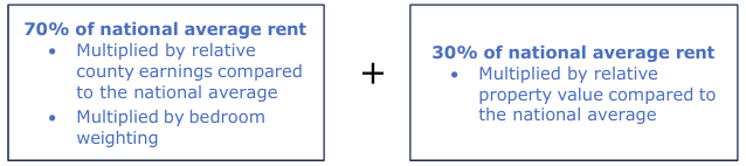
Property values are assessed against the national average, using a January 1999 valuation date. These valuations are provided by an independent valuer, using the Existing Use Valuation (EUV) basis defined in the Royal Institute of Chartered Surveyors Appraisal and Valuation Manual, PS 4.3, produced using the comparative method.
The Rent Standard only permits revaluations of properties where it has carried out major works that materially affect the value of the property. This is only likely to arise in exceptional circumstances (for example adding an extra room or extension).
For rent increases applied in the period 1 April 2026 to 31 March 2027
The weekly rent of an existing tenant of social rent housing may only be increased by up to CPI+1% in any year, subject to the rent cap requirement. However, if the weekly rent when increased by CPI+1% exceeds the rent flexibility level for the year in which the rent increase will apply, weekly rent may only be increased by up to CPI.
For rent increases applied in the period 1 April 2027 to 31 March 2028
The weekly rent of an existing tenant of social rent housing, subject to the rent cap, may only be increased by up to CPI+1% in any year, unless one of the following conditions applies:
- If the weekly rent when increased by CPI+1% exceeds the rent flexibility level for the year in which the rent increase will apply, weekly rent may only be increased
by up to CPI. - If the weekly rent when increased by CPI+1% is below formula rent for the year
in which the rent increase will apply, weekly rent may only be increased by up to
CPI+1% plus £1. However, if the weekly rent when increased by up to CPI+1% plus £1 exceeds formula rent for the year in which the rent increase will apply,
weekly rent may only be increased by up to CPI+1% plus the relevant amount that brings it to the level of formula rent for the year in which the rent increase will apply.
For rent increases applied from 1 April 2028
The weekly rent of an existing tenant of social rent housing, subject to the rent cap requirement, may only be increased by up to CPI+1% in any year, unless one of the following conditions applies:
- If the weekly rent when increased by CPI+1% exceeds the rent flexibility level for the year in which the rent increase will apply, weekly rent may only be increased
by up to CPI. - If the weekly rent when increased by CPI+1% is below formula rent for the year
in which the rent increase will apply, weekly rent may only be increased by up to CPI+1% plus £2. However, if the weekly rent when increased by up to CPI+1% plus £2 exceeds formula rent for the year in which the rent increase will apply, weekly rent may only be increased by up to CPI+1% plus the relevant amount that brings it to the level of formula rent for the year in which the rent increase will apply.
A registered provider must not charge a tenant of social rent housing a weekly rent (exclusive of service charges) that is more than the rent cap.
Curo’s policy is not to charge any social rents above formula rent plus rent flexibility.
Where existing rent charges exceed formula rent plus rent flexibility, rent increases will be capped at CPI only in line with the requirements of the Rent Standard.
Where statutory or contractual arrangements require it, we will limit rents to:
- Rent Cap – maximum limits for rents payable published by the RSH.
- Increases linked to average earnings - where specific clauses in tenancy agreements determine this.
- Section 106 caps - where specific clauses in tenancy agreements determine this.
Affordable Rent
Affordable rents are used for properties built, acquired or converted under an Affordable Homes Programme managed by Homes England or its predecessors.
For new lets and relets we set rents by reference to the gross market rent determined by a Royal Institute of Chartered Surveyors (RICS) recognised valuation method.
We set rents, that are fully inclusive of all service charges, at 80% of that market rent but, where we have evidence that this results in significant outliers to the affordability of our homes, and with the approval of the Directors of Financial Services, we may use a lower percentage.
Rents are increased each year by up to the maximum permitted by the Rent Standard, currently CPI +1%. Rent convergence is not applicable to Affordable Rent customers.
Fair Rents
Landlords or tenants of a regulated or secure tenancy that started before 15 January 1989 could apply to have a fair rent registered. The fair rent may be lower than market rent value.
Fair rent registrations can be applied for every two years, or sooner if there are major changes to a property. The registered rent is the maximum a landlord can lawfully charge and is inclusive of service charges.
We’ll apply for secure rents to be assessed by the Rent Officer Service when the registered rent is likely to exceed a comparable social rent within the next twelve months. This is subject to the legal restrictions on the earliest date by which a new application for a rent registration can be made.
Where the current rent is below Formula Rent, we will apply the increases in line Social rents. A tenant who enjoys fair rent protection must not be charged more than the lower of:
- The fair rent set by the Rent Officer; and
- The formula rent (subject to the rent caps and the rent flexibility level).
A secure tenant may move with their existing fair rent protection. On relet, we’ll charge a social or affordable rent (where applicable) unless it’s let to another secure tenant.
Keyworker, Intermediate rent and rent to buy
We set rents using the current market value, determined in the same way as Affordable Rents, discounted by 20% or such other figure as is specified in the tenancy. Subsequent increases during the term of the tenancy are determined by the contractual provisions of the tenancy agreement.
Shared ownership
We set a rent, based on a percentage of the value of unsold equity. The percentage is agreed with;
- the local authority
- the funder
- the leaseholder
Depending on the funding of the scheme, up to a maximum 3% of the unsold equity value.
Subsequently, rents will be increased each year as provided in the lease.
Temporary accommodation
We set rents on temporary accommodation properties in accordance with their tenancy agreement or license. Thereafter the rents are increased using the same methodology as Social Rent Tenancies (General Needs) above.
Fixed term tenancies
On expiry of a fixed term tenancy, we will re-set the rent using the principles above. However, where a new tenancy is being offered to the existing tenant, the initial rent will be no more than the rent at the end of the expiring tenancy, except where that date coincides with an annual rent increase. Subsequent rent increases will follow the
principles above.
This will not apply to market rent or to commercial lettings.
Market rent
We set rents at a market level, subject to any contractual obligations, and review these annually unless otherwise provided in the tenancy.
A market rent setting procedure ensures that market rents (and those derived from the market rent) are determined in a consistent way, using an RCIS certified valuer. The procedure also sets clear boundaries for any discretion given to colleagues involved in negotiation with customers.
We set and charge market rents on a monthly basis.
Commercial properties
We set commercial property rents on a current market rent which is then reviewed on the renewal date of the lease, or review date within the lease.
Service Charges
We charge a service charge (where relevant) in addition to the net rent for Social Rent tenancies and for shared ownership leases.
Garages
We set garage rents annually based on an assessment of affordability, income optimisation and current market rates. Such factors as the economic climate, customer demand, conditions of units, tenure of the tenant (i.e. existing Curo tenant, leaseholder, non-resident), and geography will be taken into account.
Where required by tax legislation, VAT will be charged in addition to the rent.
Stock managed by others
Where our housing stock is managed by another organisation which is not a registered social housing provider, the management arrangements will ensure that we set the rent for the property.
5. Application
Our processes for setting and increasing rents ensure that we are compliant with legislation. Tenants can appeal if they think we have got something wrong.
For all social properties, rents are charged on a weekly basis throughout the year, except where an existing legacy tenancy agreement requires us to do otherwise. Market Rents are charged on a monthly basis.
We review our processes for increasing rents, including the notices we send to tenants, annually. At least every two years we include external, legal, advice as part of that review. This ensures that we remain compliant with legislation, regulation and good practice.
Internally we review letters and notices to ensure their clarity and customer focus.
6. Procedures
The following procedure documents support the application of this policy:
- Rent & Service Charge setting procedure
7. Equalities Assessment
Curo believes that the application of this policy, which is based on objective criteria relating to properties, will not result in any adverse impact on one or more groups of people.
The policy ensures that rents are not increased as a result of adaptations carried out to meet the needs of particular groups.