Curo Communal Utilities Management Procedure 2026-2028
by Director of Estates Services
Table of Contents
- Summary - page 3
- Procedure Scope - page 3
- Reasonable Adjustment - page 3
- What is a Communal Supply? - page 3
- Utilities Emergencies - page 4
- How do we get you good value for money? - page 5
- OFGEM and Energy Price Cap - page 6
- Water Services Regulation Authority (OFWAT) - page 6
- How do I find a Supply Identification Number? - page 6
- Utility Service Charges - page 7
- Residential Utility Supplies - page 7
- Finding the Communal Meter - page 7
- Supply Disconnections - page 8
- Incoming Consent Request from Utility Provider - page 9
- Utility Provider Work Requiring Access to Properties and/or Curo to complete work - page 9
- Tenants Choice of Utility Provider - page 9
- Sale of a Freehold - page 10
- New Developments - page 10
- Redundant Utility Supplies - page 10
- Electricity Generation/Transmission and Distribution - page 11
- Different Types of Electricity Meters - page 12
- What are District/Local/Independent Network Operators (DNO/LNO/INO)?- page 15
- LNO/DNO – Priority Service Register - page 16
- Meter Operator, Data Collector and Data Aggregator Agreements -page 16
- Unmetered Supplies (UMS) - page 17
- Meter Radio Teleswitch Service (RTS) and the Switch-Off - page 17
- Smart Meter Upgrade Programme/Meter Reads - page 18
- Communal meter space not adequate for a Smart Meter - page 18
- Smart Meter – No Mobile Data Signal - page 18
- How will the closure of 2G and 3G affect our Smart Meters? - page 19
- Legal Requirement to Replace Old Electricity Meter - page 19
- Shared Electrical Main Fuse - page 20
- Meter Operator Provider (MOP) - page 20
- Street Lighting - page 20
- Street Lighting Owned by Parish Councils - page 21
- What are Heat Networks? - page 21
- Maintenance of District Heat Network Equipment - 22
- Bath Riverside Housing Association (HA) Charges - 23
- Can Customers install Solar/PV Panels on their property? - page 23
- FIT (Feed-in Tariffs) - page 24
- Why am I not being billed for individual water use and paying a split of the landlords’ bulk meter? - page 24
- VAT Standard Industrial Classification (SIC) Codes - page 24
- Water Rateable Value - page 25
- Reconnection of Temporarily Disconnected Water Supply - page 25
- Challenging Utility Bills – Supplier and Energy Ombudsman - page 25
- Empty Homes Utilities Bills - page 26
- Curo/Landlords Communal Energy Bills Delivered to a Property - page 26
- Management of Communal EV Charging Points - page 27
- Openreach Wayleave Agreements - page 27
Communal Energy General
1. Summary
Curo ensures that all our communal properties and spaces have adequate lighting, safety services and other required utilities.
As a property landlord, we have a direct responsibility for ensuring our utilities are managed appropriately. This policy sets out our approach to Utility Management.
2. Procedure Scope
This procedure applies to all communal energy supplies under the ownership/management of Curo.
Although, we believe this management procedure to be as comprehensive as possible, Curo acknowledges it does not cover every situation. We reserve the right to exercise discretion in application of this policy when to do so would be in the best interests of Curo and its Customers.
3. Reasonable Adjustment
Colleagues are empowered to make reasonable adjustments based on individual customer needs ensuring equal access to services.
Colleagues are encouraged to assess each situation thoughtfully and make adjustments where appropriate, considering factors such as accessibility, medical or specific requirements. These adjustments should be made in a way that meets statutory and regulatory requirements, maintains a high standard of service, and supports customers in a fair and respectful manner.
4. What is a Communal Supply?
Energy (gas, electricity and water) supplied to the areas that Curo either lights, heats or provides power to outside of your own front door is referred to ‘communal energy’ or a ‘communal supply’. For example, the lighting in the corridor leading to your flat, or the power to the door entry system.
Note: The above statement is not applicable to properties supplied by District Heating Networks that provide heat and hot water for individual properties.
Examples of our current communal supplies are as follows:
Electricity:
- Fire and smoke alarms, emergency lighting and automatic opening valves (AOVS)
- Internal and external lighting
- Street and car park lighting
- Lifts and chairlifts
- Door entry systems
- Laundry equipment
- Heaters
Gas:
- Hot water boilers
- District Heat Network Energy Centre Equipment
Water:
- District Heat Network
- Kitchens
- Bathrooms
- Laundries
- Bin stores
- External taps
5. Utilities Emergencies
Report the emergency to the relevant agency as directed below.
Gas leak
If you can smell gas and/or think there could be a leak, call the emergency helpline immediately and evacuate the property immediately.
24 Hour Gas Emergency Helpline: 0800 111 999
Power cut
If you experience a power cut that you weren’t expecting, you can report it by calling 105.
This will connect you to your distribution network operator who owns and maintains the power lines that connect to homes and businesses.
External water leak/blockage/pollution
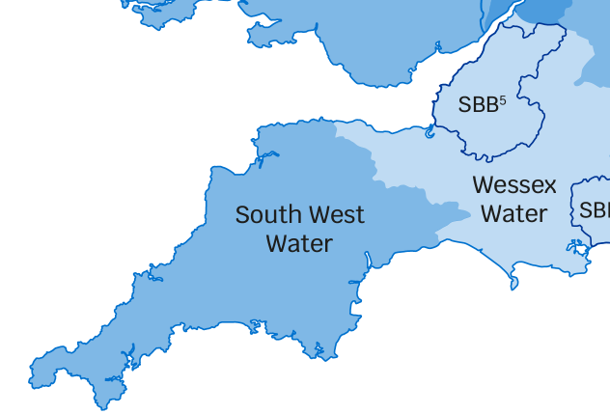
Referring to the map below, call the relevant Water Company.
Bristol and Wessex Water: 0345 600 4 600
Southwest Water: 0344 346 2020
Customer Advice: One of the relevant agencies above should attend promptly to act upon the report. Ensure the customer is aware they need to vacate the property or area if they can smell gas.
6. How do we get you good value for money?
Procedure: We are always looking at ways to get better value for money from the electric, gas and water companies who supply our communal areas. Our Energy Manager reviews the deals available when our current deals end and will choose the best value for money offer.
Transmission Network Use of System (TNUoS) is a method to
recover the cost of installing and maintaining the transmission system in England, Wales, Scotland, and Offshore. This charge is calculated using a banding system called Targeting Charge Review (TCR) for businesses based on average consumption to ensure a fair charge for companies that cannot chose when they use energy. This TCR dictates the Standing Charge for the property.
The previous system, TRIAD, ended in 2023 (Tri referring to three and AD for average demand) which used to reward companies that could reduce their consumption during the three highest periods of national demand.
Curo response to this enquiry: One of our Energy Team also completes a review of the TCR banding before securing energy contracts to ensure the Standing Charges are correct.
Customer Advice: If any customers have further queries, these can be raised as a service charge query by our Customer Contact Team.
7. OFGEM and Energy Price Cap
Procedure: Office of Gas and Electricity Markets (Ofgem) is Great Britain’s Independent energy regulator. They work to protect energy customers, especially vulnerable people, by ensuring they are treated fairly and benefit from a cleaner, greener environment. The energy price cap is the maximum amount energy suppliers can charge you for each unit of energy and standing charge if you are on a standard variable tarrif.
Curo response to this enquiry: The Ofgem energy price cap is only applicable to household energy and does not apply to Curo communal energy as they are on businesses tarrif prices.
Customer Advice: Our communal supplies are business energy, so we do not qualify to the price cap.
8. Water Services Regulation Authority (OFWAT)
Procedure: OFWAT is a non-ministerial government department. We were established in 1989 when water and sewerage industry in England and Wales was privatised. They are the economic regulator of the water and sewerage sectors, we: protect the interests of consumers, wherever appropriate by promoting competition. make sure that the water companies properly carry out their functions. ensure that the water companies can finance their functions.
9. How do I find a Supply Identification Number?
Procedure: Utility companies identify the location of their supplies to properties using identifier numbers. They can be found on utility bills, by calling the supplier or using online searches to find my MPAN, MPRN or SPID.
Electricity: Meter Point Administration Number (MPAN)
Gas: Meter Point Registration Number (MPRN)
Water and Sewerage: Supply Point Identifier Number (SPID)
Curo response to this enquiry: We are aware of the identifier numbers for our communal supplies.
Customer Advice: A customer can check the same way detailed in the procedure to find their own Identification Numbers if they are unsure who their supplier is.
10. Utility Service Charges
Procedure: The communal energy service charges are based on an estimate of the expected annual running costs. Using the existing energy tarrif prices, a calculation is made based on previous consumption.
Curo response to this enquiry: A service charge query can be raised on QL to provide the customer with more information, if required, about these charges.
Customer Advice: A colleague will review the service charge query and contact the customer to assist with their enquiry.
11. Residential Utility Supplies
Procedure: The Energy Team is only responsible for managing the communal supplies. However, if a customer is experiencing difficulties with their supplier or reading a meter, the Energy Team will try and assist them.
Curo response to this enquiry: Report general electrical or gas faults to the Curo repairs team. Report difficulties with the supplier to a member of the Energy Team.
Customer Advice: We can’t really assist with supply or metering issues within the home; the utility provider must be contacted. If the supplier has already been contacted and there is no resolution, contact the Energy Team.
Note: District Heat Networks are managed differently, check with Energy Team who the supplier is at some sites, as Curo could be the supplier.
12. Finding the Communal Meter
Procedure: We are planning to put all the meter locations on QL but in the interim, the communal power supply meter is usually in the following places.
- Electrical – Inside the property in the meter cupboard, external stores or in the white electricity box on the exterior wall (marked with a lightning bolt logo).
- Gas – Outside of the property in the white gas box (marked with a G), inside the property or in the boiler room/energy store.
- Water – In the pavement or road, access via a small circular or square flap or in cupboards outside of flat front doors.
Curo response to this enquiry: We are gathering data on meter locations and should in the future, know the exact location of them all.
Customer Advice: None
13. Supply Disconnections
Procedure: Depending on the type of communal supply that needs disconnecting, the following companies will need to be contacted:
- National Grid: Call general enquiries with address and relevant MPAN. They will arrange for a surveyor to attend the site and provide a quote for the disconnection of the supply from the grid.
- SMS: Call or email the business SMS for gas meter removals. They will need photographic evidence that the meter is capped and is no longer connected to any appliances before sending an engineer to remove the meter.
- Bristol and Wessex Water or Water2Business: Our Energy Team will call the relevant supplier to arrange a temporary water disconnection. A surveyor will attend the site to ensure that the supply is independent and locate the main stop-tap. The supply will then be turned off at the stop-tap, and billing will cease. In the future, if the supply is required again; a small fee can be paid to reconnect it.
A permanent disconnection will require underground pipes to be removed which will incur costly works so it’s preferrable to complete a temporary disconnection instead.
Curo response to this enquiry: Supply disconnections are managed by the Energy Team/Estates Team.
Customer Advice: Communal utility supplies are managed by the Energy Team. Supplies and meters which are no longer required will be removed and the relevant provider informed to prevent further billing.
14. Incoming Consent Request from Utility Provider
Procedure: Consent from Curo is required for any form of trenching work that is to be carried out through Curo-owned land or for replacement of external supplies/cables/pipes to our properties.
Curo response to this enquiry: An agreement will be entered into between the provider and Curo whereby any works carried out must follow and adhere to industry best practice and guidance.
Customer Advice: A consent form can be completed or an email regarding the works sent to a member of the Energy Team. A joint visit by the manager and the utility provider is usually completed before any planned work is permitted.
15. Utility Provider Work Requiring Access to Properties and/or Curo to complete work
Procedure: There will be occasions that Utility companies require access to properties or sites.
Curo response to this enquiry: Contact a member of the Energy Team to gain consent for works or access. The provider is responsible for contacting customers and informing persons in the area of the planned work.
Customer advice: None
16. Tenants Choice of Utility Provider
Procedure: Curo have contracts in place for the communal utility supplies only. Tenants can choose their own provider for all utility supplies within their home.
Note: This is not the case for those supplied by District Heat Networks.
Curo response to this enquiry: If the tenant is responsible for the payment of utility bills, they are allowed to choose who supplies their service.
Customer Advice: The tenant will need to contact the supplier of their choice to arrange for the account switch to occur.
17. Sale of a Freehold
Procedure: If a property freehold is purchased then Curo will no longer have responsibility for any of the services to it.
Curo response to this enquiry: Once we receive the relevant legal paperwork from the customer/Curo sales team, we can contact the communal utility suppliers to change the account information.
Customer Advice: To complete a change of tenancy, the following documentation is required.
A copy of the lease surrender document that details the tenant’s liability, or if the tenant is not liable, the landlord details. We need a contact name, phone number, e-mail and mailing address (if different to the premise).
18. New Developments
Procedure: The Property Information Form (PIF) will contain information regarding any communal utility supplies on the site. This information will be provided to the Energy Team to manage the transfer of the utility account, registration of new supplies with our broker, and assess which customers will incur a utility service charge.
Curo response to this enquiry: None
Customer advice: None
19. Redundant Utility Supplies
Procedure: Curo often carries out upgrades to systems like heating or warden alarms or remove services no longer required like laundry rooms.
Curo response to this enquiry: Take the details of the supply/service to inform the Energy Team.
Customer Advice: Communal utility supplies are managed by the Energy Team. Supplies and meters which are no longer required will be subsequently removed and the relevant provider informed to prevent further billing.
Electricity
20. Electricity Generation/Transmission and Distribution
Procedure: Electricity is generated by a mix of traditional fuel power such as coal and natural gas and renewable energy like wind, solar or nuclear energy at power plant stations.
Electricity transmission: Overhead power lines attached to pylons (metal towers) quickly move large amounts of high voltage electricity across long distances.
Electricity distribution: Electricity from the transmission network is taken and changed into safer levels (low voltage). Distribution network operators share this with local areas and communities so it can reach homes, businesses and buildings.
Who is involved in transmitting electricity:
National Energy System Operator (NESO) manages the flow of electricity from generation to transmission. They responsible for planning and coordinating the design of electricity networks. This includes making sure there is enough supply to meet consumer demand.
There are 3 companies that manage electricity networks in Great Britain (England, Scotland and Wales). These are:
- National Grid Electricity Transmission
- Scottish Power (SP) Transmission
- Scottish & Southern Electricity Networks (SSEN) Transmission
Transmission owners maintain the electricity supply and pass this supply on to distribution network operators. They also carry out the work to connect large demand customers and generators to the electricity network.
21. Different Types of Electricity Meters
Procedure: There are a range of different types of meters measuring the consumption of electricity in our communal areas. This is due to the date the property supply was connected and the type of meter manufactured at that time. Meters have a certification date set by the Office for Product Safety and Standards (OPSS). Once this date is passed, the governmental regulations must be adhered to, and the meter will need to be replaced.
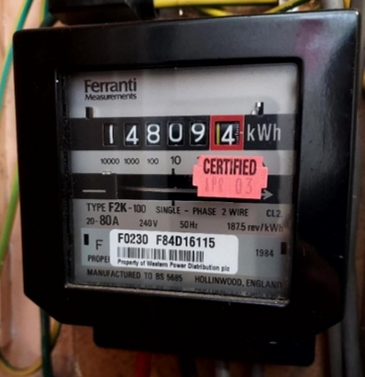
Standard:
This meter uses a mechanical display to show your reading of five black numbers from left to right and two red numbers.
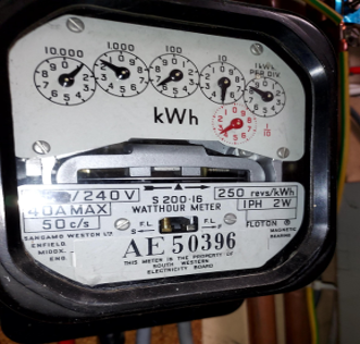
Dial:
This looks like a line of clocks. When reading your dial meter, always remember that dials next to each other go around in opposite directions. If the needle is between two figures, note the figure the dial has just passed.
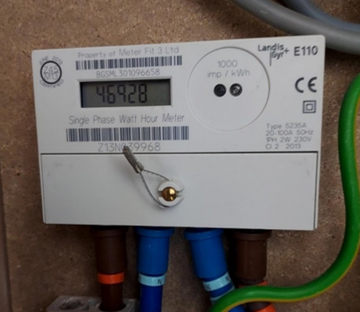
Digital meters:
Use the first five figures on the digital display and ignore any last figure that begins 0.1. You may need to press a button to get the figure to display.
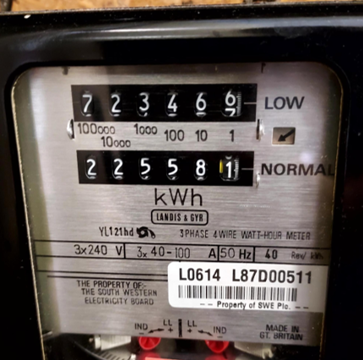
Economy 7/Dual Rate:
There are two types of Economy 7 meter. The first type has two displays - the top row is marked 'Low', shows the 'night rate'. The bottom row is for 'day rate' electricity marked 'Normal'.
Automated Meter Reading (AMRs):
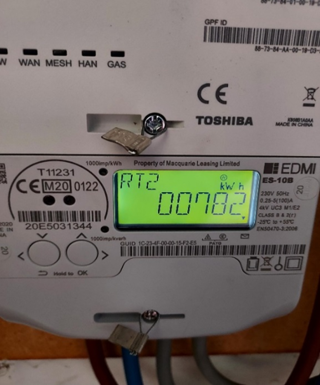
AMR means Automated Meter Reading or Advanced Meter Reading. These meters are early versions of the new Smart Meters and can measure and store energy usage for multiple time periods.
Less advanced AMRs require the data to be collected by a portable collection device that is either used next to or within the vicinity of the meters located.
More advanced AMRs can now send meter consumption data and readings via the mobile phone network automatically to the energy suppliers.
Smart (SMETS1 &SMETS2):
Automated Meter Reading meters and Smart Meters are similar, but they operate using different technologies. AMRs have a Subscriber Identity Module (SIM) within them that transmits data over a mobile network, whereas Smart Metering Equipment Technical Specifications (SMETS) meters use a communications hub to transmit data.
SMETS 1 are the first-generation of SMART meters and they use 3G whereas the SMETS 2, second-generation, use 2/3G service to transmit readings.
Half Hourly (HH):
This is compulsory for businesses that consume 100 kWh of electricity or greater in any half-hour period. As the name suggests, a meter read is sent to the supplier every half hour. For these, a meter operator, data collector, and data aggregator agreement must be in place.
Non-Half Hourly (NHH):
Readings from these meters are typically taken manually or automatically and record consumption either monthly, or quarterly.
Curo Response to this enquiry: Using the information above, the relevant response can be provided.
22. What are District/Local/Independent Network Operators (DNO/LNO/INO)?
Procedure: The network operator manages the wires, cables, and substations. They're not your energy supplier and they don't bill you. They get paid by the energy suppliers. They can help with things like connecting your home to power, moving your meter, registering you for the Priority Services Register or assisting you if there's a power cut.
If you have a problem with your direct debit or your energy bill, you'll need to speak to your energy supplier. Their details can be found on your bill.
Curo response to this enquiry: There are two network operators in the South West - Scottish and Southern Electricity Network and National Grid (previously Western Power). Independent Networks Operators are for embedded properties, and their details can be found on the supply bill.
Customer Advice: None
23. LNO/DNO – Priority Service Register
Procedure: The Priority Services Register is a free service to help people who have additional needs. It’s available to customers in England, Scotland and Wales. You can sign up by contacting your local network operator or energy supplier.
Curo response to this enquiry: The type of help available will vary, depending on your circumstances and the support provided by your local network operator.
Advance Notice of Power Cut: If you rely on your energy supply for medical reasons, your network operator can tell you about planned power cuts. For example, when there are planned engineering works. Being on a Priority Services Register won’t mean your electricity supply will be restored more quickly or guarantee a power supply if there is a power cut.
Priority Support in an Emergency: Network operators can provide heating and cooking facilities or accommodation and direct contact and updates, such as by phone.
An identification and password scheme is available. This could include arranging a password or pictures only you and your local network operator will know. The network operator will use these forms of identification so can feel confident they are who they say they are if they need to visit or contact you.
Being registered for priority services does not guarantee a continuous supply of energy. As supply interruptions can happen all year round, it’s important you are prepared and know what to do if they happen.
Customer Advice: Contact your energy supplier to find out who your network operator is. Once you know this, you can contact them to see if you are eligible to be registered for the Priority Service.
24. Meter Operator, Data Collector and Data Aggregator Agreements
Procedure: It is compulsory for businesses that consume 100kWh of electricity or greater in any half-hour period to have a half-hourly meter fitted. If you have a half-hourly meter, you need to have a meter operator, data collector, and data aggregator agreement in place. These can be obtained and billed through the energy supplier or independently by a Meter Operator company like STARK or Western Power.
Curo response to this enquiry: Curo has the following sites which have half-hourly meters fitted:
- Landlords Supply Ballance St
- Hawthorns House
- The Maltings
- Greenacres Court
- Mulberry Park Community Hub
Customer advice: None
25. Unmetered Supplies (UMS)
Procedure: An unmetered connection is a supply to equipment which does not require a meter, e.g. street lights, traffic signals and some communications cabinets.
The Electricity (Unmetered Supply) Regulations 2001 have set up strict criteria to decide what equipment is eligible for an unmetered connection.
Curo response to this enquiry: Queries about UMS need to be directed to National Grid Unmetered Supplies Operator (UMSO).
Customer advice: None
26. Meter Radio Teleswitch Service (RTS) and the Switch-Off
Procedure: The RTS used a radio signal to tell some older electricity meters when to switch between peak and off-peak rates. This service has now ended as RTS equipment reached the end of its operational life.
Curo response to this enquiry: We have exchanged all our RTS electricity meters to Smart Meters which switch automatically between rates.
Customer advice: Customers that have old meters which relied on the RTS to switch rates will need to contact their own supplier to upgrade the meter. If they chose not to upgrade to a Smart Meter, heating and hot water in their home could be affected. The heating and/or hot water may be continually on or off or turning on at the wrong times of day. Their supplier won’t be able to confirm how much electricity is used during peak or off-peak times, resulting in an increase in cost.
27. Smart Meter Upgrade Programme/Meter Reads
Procedure: Curo is supporting the Department of Energy & Climate Change with the roll out of Smart Meters. These will play an important part in Britain’s transition to a low-carbon economy. These meters also provide regular readings to the supplier to ensure the bills we receive accurately reflect the usage. There are some meters we cannot currently upgrade due to other external contractor works being required first.
Manual Meters: Where we still have communal electro-mechanical meters fitted, the Energy Team collects readings from these at least once per year.
Curo response to this enquiry: No action.
Customer Advice: The Energy Team has an upgrade program in progress and is aware of those meters which still require manual reads submitting to the suppliers.
28. Communal meter space not adequate for a Smart Meter
Procedure: There are sites where the current meter cupboard space is not big enough to house a smart meter.
Curo response to this enquiry: The Energy Team and Fire Safety Team are working together to create larger meter spaces where required.
Customer Advice: None
29. Smart Meter – No Mobile Data Signal
Procedure: Due to the location of some meters, there is an insufficient mobile phone signal for the Smart Meters to communicate and send their readings to the supplier. A booster aerial can be fitted by the supplier but if this fails, the Smart Meter will remain in ‘Dummy mode’ and readings will need to be gathered and submitted manually.
Curo response to this enquiry: The Energy Team are aware of meters that are required to be read manually, and regular readings are collected and submitted to the supplier:
Customer Advice: None
30. How will the closure of 2G and 3G affect our Smart Meters?
Procedure: To free up valuable radio spectrum for 5G and future services and ensure the UK remains connected to the latest technology, the UK Government announced that 2G and 3G services will be closed by 2033.
There are two types of Smart Meters. The first-generation (SMETS1) and second-generation (SMETS2).
Curo response to this enquiry: Properties with SMETS1 meters will stop producing automatic readings once all the 3G service in its locality has been turned off. We are in the process of getting these meters upgraded by our supplier.
Properties with SMETS2 meters will stop working in 2033 when the 2G service is closed. We are working closely with our energy supplier who will need to produce a new communications hub for the meter so that it will work with 4/5G. Again, we will be running a program to get the new hubs fitted once they are available.
Customer Advice: The Energy Team will upgrade any communal meters. Your energy supplier should be in touch to upgrade the meter in your home. In the interim, once the 2/3G services are turned off, you may need to provide manual readings to your supplier.
31. Legal Requirement to Replace Old Electricity Meter
Procedure: Meters need to be replaced every 10 to 20 years. As meters get older, they might not record your usage as accurately as they used to. Suppliers determine when this needs to be done by checking a meter ‘certification date’. The supplier has a legal obligation to exchange it with a new one and will get in touch with the meter owner when this exchange is due.
Curo response to this enquiry: The Energy Team is aware of those meters that need replacing and is making the relevant appointments with our supplier to upgrade them.
Customer advice: Letters advising meters need replacing are often sent automatically to the site address. If a letter has been sent to the property address for the communal meter replacement, please advise customers to disregard it as we are managing the meter replacements.
32. Shared Electrical Main Fuse
Procedure: On occasion, where Curo has a communal electric supply, the incoming connection fuse could be shared with one of the flats within the property.
Curo response to this enquiry: If planned electrical work, like a meter replacement, is required in the communal area or the flat sharing the fuse, there could be a requirement to ‘pull’ the fuse. This will cause an interruption to power in both the flat and communal areas.
Customer Advice: Please ensure that the Energy and Fire Safety Team are aware of the planned works so that they can act accordingly.
33. Meter Operator Provider (MOP)
Procedure: A Meter Operator (MOP) is a certified company that is appointed by an energy supplier to install, maintain and remove metering equipment. If something goes wrong, they will ensure that your meters are fixed quickly and properly to limit disruption to the business. If the supply contact and MOP agreement are separate, typically an annual fee is paid directly to the MOP (STARK for example). Alternatively, MOP fees are included in the main contact with the supplier.
Curo response to this enquiry: For any further queries, contact the Energy Team.
Customer Advice: None
34. Street Lighting
Procedure: Curo owns and maintains certain streetlights across our Estates. To identify the owner of the streetlight, ARC GIS can be consulted. There are some anomalies, like in Peasedown St John, where the streetlights are still owned by the Parish Council and not Curo or Bath and Northeast Somerset Council (BANES).
Curo response to this enquiry: Use ARC GIS/Estates mapping to identify the owner of streetlight using the layer list as shown below.
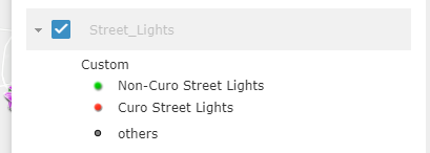
Customer Advice: If the light belongs to CURO, a repair can be raised. If they belong to another agency, the fault will need to be reported accordingly. BANES have a website called Fix My Street.
35. Street Lighting Owned by Parish Councils
Procedure: There are areas where the street lighting is owned by the local Parish Council.
Curo response to this enquiry: Using the Estates map or the Fix My Street websites, please identify who owns the streetlight.
Customer Advice: Please get in touch with your local Parish Council to discuss your query regarding their lights.
Heat Networks
36. What are Heat Networks?
Procedure: There are two types of Heat Network – Communal Heating and District Heating. These networks provide heating and/or hot water to individual properties.
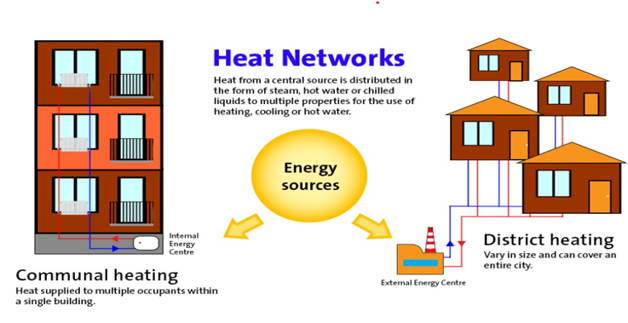
Curo response to this enquiry: We have the following District Heating sites:
- Ballance St Estate incorporating Morford St, Lampards
- Buildings and Jaguar House, Bath
- Park Road, Trowbridge
- Hazel St, Urban Quarter, Bristol
- Old Gaol, 16 Grove St, Bath
- Lawn Close, Stoke Gifford, Bristol
- Midland Rd/Jubilee Street, Bristol
Customer Advice: The relevant teams are aware of the sites listed above. and customers moving into properties with District Heating will be informed and provided with the relevant information.
37. Maintenance of District Heat Network Equipment
Procedure: There are different contracts across our Heat Network estates for remote diagnostic assistance, maintenance of the metering equipment and network, and dealing with equipment within the properties (e.g radiators/thermostats etc).
Curo response to this enquiry: The following networks use the Energy, Maintenance and Billing providers detailed below.
| Network | Energy/Account Provider | Maintenance | Billing Contact for Updates |
|---|---|---|---|
| Bath West Riverside | E.ON heat | Remote and Network: E.ON Heat Internal: Curo |
E.ON Heat SME Billing: heatsmebills@eon.com Liz Turner |
| Ballance Street | Curo (Total Gas) | Remote: Lanten Internal and Network: Curo |
Lanten: inquiry@lantenltd.com |
| Jubilee/Midland Street | Vattenfall Heat UK/Curo | Remote: Minibems Boiler Room Internal: Curo |
Evinox Residential: billing@evinoxresidential.co.uk |
| Hazel Street | Tillia Homes/HLM Managing Agent | Remote and Internal: Evinox | Evinox Residential: billing@evinoxresidential.co.uk |
Note: Lawn Close, Old Gaol and Park Road supplies are currently unmetered and have no equipment to maintain or billing provider.
38. Bath Riverside Housing Association (HA) Charges
Procedure: Residents pay a contribution towards the running cost of the District Heat Network (DHN) and Energy Centre (EC) on their monthly billing called a Heat Service Energy Charge. This is set at 40% of the cost – estimated at 26p per day per household in 2024. They don’t pay a daily standing charge like general households do, just this Heat Service Energy Charge.
Curo pay a Housing Association Service Energy Charge to EON, set at 60% of the DHN and EC running cost. This is charged to us monthly at in 2024, 42.44p a day, for each of the household units on the development.
Curo response to this enquiry: As above.
Customer advice: Queries about billing for inside customers' homes will need to be directed to E-ON. If E-ON, cannot help, consult Curo Energy Team.
Solar Energy
38. Can Customers install Solar/PV Panels on their property?
Procedure: Solar panels, or photovoltaics (PV), capture the sun’s energy and convert it into electricity to use in your home.
Installing solar panels lets you use free, renewable, clean electricity to power your appliances. You can also sell excess energy back to your supplier through the Smart Export Guarantee Scheme.
Curo response to this enquiry: We do not permit customers to install their own PV panels or sign up to the Smart Export Guarantee Scheme.
Customer advice: We do not permit customers to install their own PV panels or sign up to the Smart Export Guarantee Scheme.
39. FIT (Feed-in Tariffs)
Procedure: Under the Feed-in Tariff scheme (FITs), householders/landlords receive payments for the electricity generated by eligible installed systems like solar PV.
If you already have an eligible installed system that you are receiving FITs payments for, you are unaffected by the scheme closure in 2019. You will continue to receive FITs payments as normal.
Curo response to this enquiry: None
Customer advice: None
Water
40. Why am I not being billed for individual water use and paying a split of the landlords’ bulk meter?
Procedure: There are some sites across our Estates that do not have Bristol and Wessex Water meters at the properties. The meters fitted during development are private, and Bristol and Wessex water will not replace them or take responsibility as directed by OFWAT regulations.
Curo response to this enquiry: Curo pay for the water used and charges on the main landlords/bulk meter. This charge is then equally divided between the flats in the block and is Service chargeable.
Customer advice: Individual billing on the private meters has been explored but would add a high monthly cost to our customers. The cheapest and fairest route is the current one, where the main bill is split between all the flats in the block.
41. VAT Standard Industrial Classification (SIC) Codes
Procedure: When a new supply is registered, our broker will ask for a SIC code to describe what our business does. This is important as it will register the site for a flat rate VAT scheme.
Curo response to this enquiry: If requested, our broker can send over a list of all the SIC codes or codes are available online.
Customer advice: None
42. Water Rateable Value
Procedure: If a property doesn’t have a water meter fitted, the supplier will charge an unmetered charged. These are based on the rateable value of your property and not the amount of water you use. The supplier is required by law to use the rateable values last set by the valuation officer of the Inland Revenue on 31 March 1990. Rateable values are different for each property.
Our response to this enquiry: None
Customer advice: They will need to contact their water supplier to find out what their rateable value is.
43. Reconnection of Temporarily Disconnected Water Supply
Procedure: Temporarily disconnected water supplies can be reconnected as required. If the supply has been disconnected for over 90 days, a Chlorination Certificate will need to be obtained before approaching the water supplier to reconnect.
Curo response to this enquiry: If under 90 days, call the supplier (Water2Business or Bristol and Wessex Water) to arrange reconnection. If over 90 days, arrange for a Chlorination certificate to be provided first.
Customer Advice: No advice.
Energy Billing
44. Challenging Utility Bills – Supplier and Energy Ombudsman
Procedure: Our Energy Team manages any disputes over billing for our communal supplies. Customers may also experience issues with billing which could be caused by estimated readings, smart meters losing connection/communication, or a water leak for example.
Curo response to this enquiry: In the first instance, for private supplies, the customer will need to contact their supplier regarding the issue. If the issue is not resolved within 8 weeks or they send a deadlock letter, the dispute can be escalated and raised with the Energy Ombudsman.
Note: Curo is the supplier for our Ballance St Estate Heat Network.
Customer advice: If they haven’t already, contact their supplier and work with them to try and resolve the issue. If they have tried this, but the supplier is indicating a landlord’s electrical issue or if the customer is seeking further advice, please notify the Curo Energy Team of the query.
45. Empty Homes Utilities Bills
Procedure: If a customer vacates the property, Curo becomes responsible for all utility bills until a new customer begins their lease. Utility providers will ask for a meter reading from the day the previous customer vacated the property and from the day a new customer moves in, so bills will be calculated based on the usage between these dates.
Curo response to this enquiry: Any bills indicating specific Flat Numbers are usually for an empty home and need to be passed to the relevant team.
Customer advice: If the customer has received bills for a period the home was empty or have a query regarding the handover of the supply, please pass the query to the relevant team managing Lettings.
46. Curo/Landlords Communal Energy Bills Delivered to a Property
Procedure: There have been occasions where the supplier has been sending communal energy bills directly to the property instead of to the Curo office. This needs to be addressed as soon as possible to ensure that bills are paid in a timely manner.
Curo response to this enquiry: Copies of these bills need to be given to the Energy Team/Estates Team to get them registered with our broker and paid immediately.
Customer advice: If possible, please can a photo of the bill be provided so that the details needed to transfer and discuss the account can be obtained. Reassure the customer that the issue will be resolved and if there are any letters saying that the supply is at risk, these can be ignored.
Electrical Vehicle Charging
47. Management of Communal EV Charging Points
Procedure: Curo is responsible for the Communal EV charging points across our Estates. The Energy Team review the charges for the electrical supply to the point and will inform the relevant billing agent what rate is charged to users.
Curo response to this enquiry: Charging points display the information required by users to create accounts and use the point for charging.
Customer advice: Customers should follow the directions displayed on the charging point. If they are experiencing difficulties, contact the number displayed. Following this, please pass any queries to the Energy Team.
Wayleave Agreements
48. Openreach Wayleave Agreements
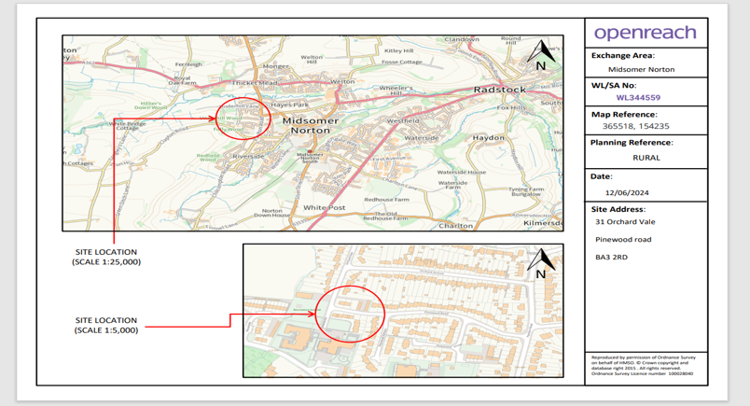
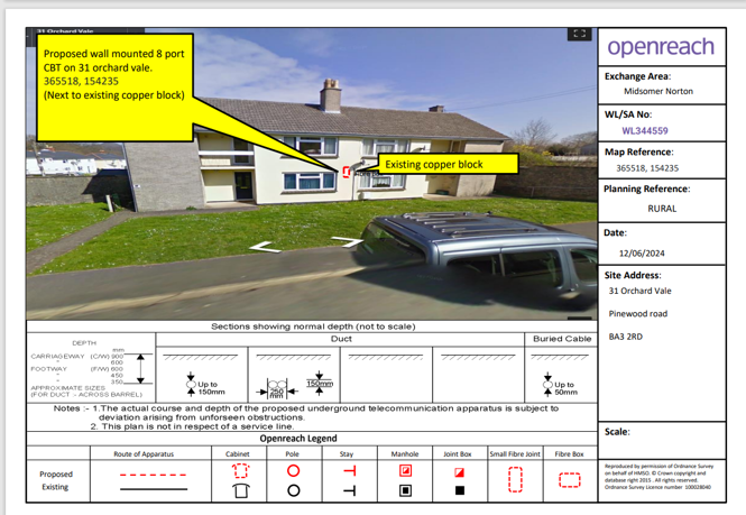
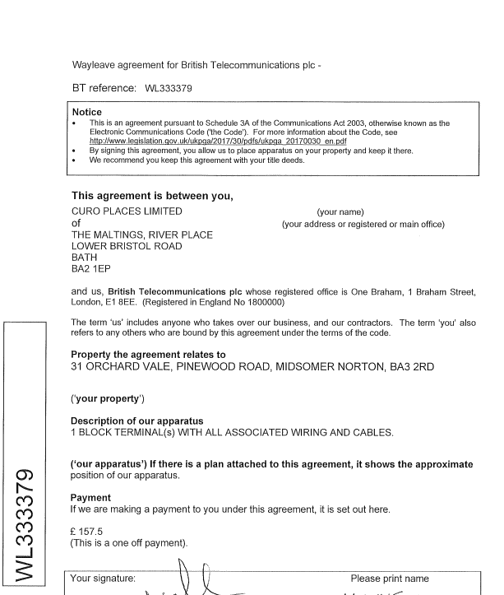
Procedure: These agreements are where suppliers need to place their apparatus on Curo land or property. This agreement normally involves a one of payment to Curo.
Curo response to this enquiry: Check that planned apparatus location does not have impact and consent as required.
Customer advice: None
Example of Wayleave Agreement and Plans: